
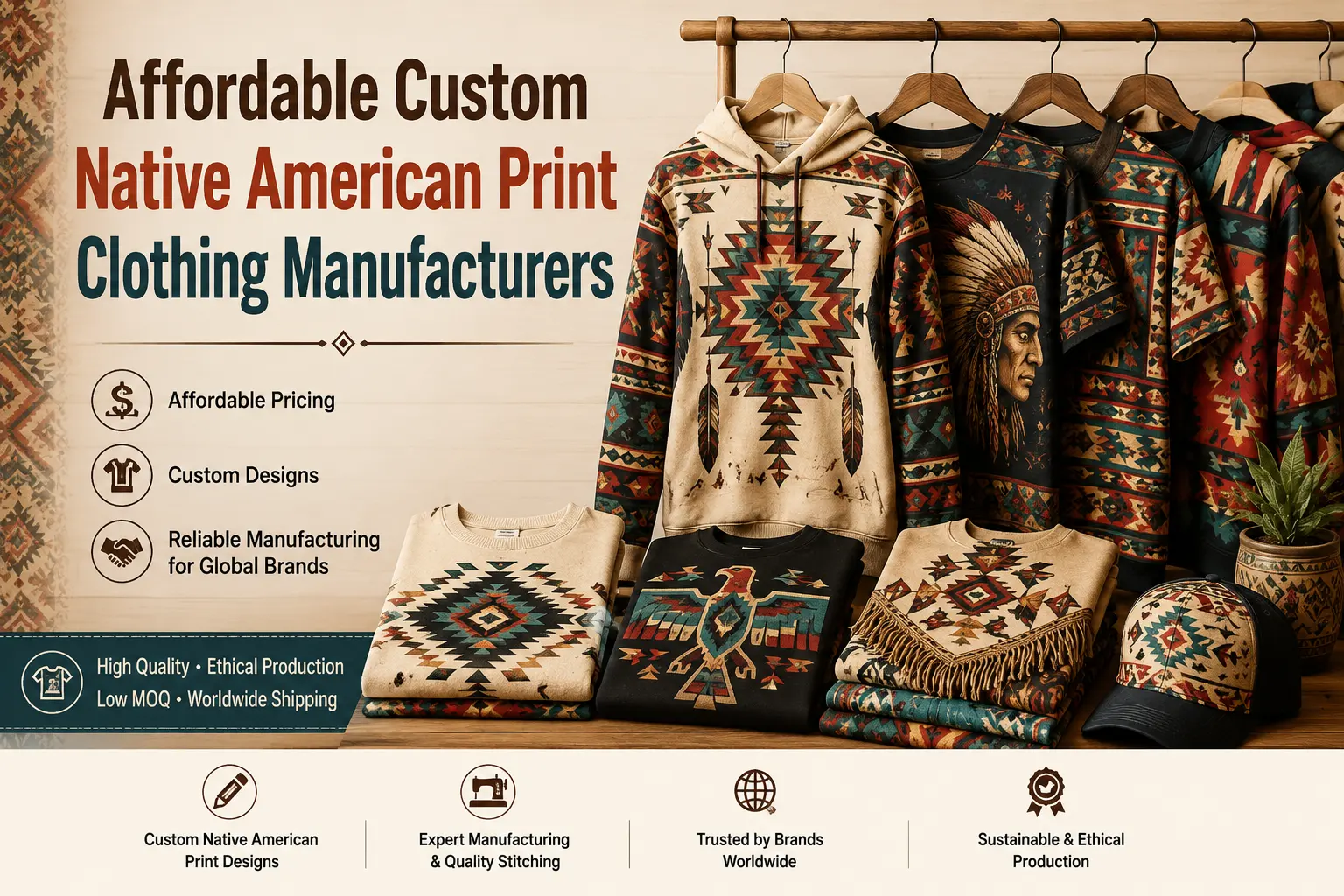
Texasia is a manufacturer that produces custom apparel for brands worldwide. This guide covers affordable custom native american print clothing manufacturers and what buyers need to know. The service fits small startups, boutiques, and growing fashion labels. Buyers get full customization on fabric, print method, and packaging. Order sizes range from small test batches to large bulk runs. Native artists can join the design process when a client requests this option. Low overhead production in Bangladesh keeps pricing fair for every order size.
What Are Custom Native American Print Clothing Manufacturers?
A custom clothing manufacturer builds apparel from your artwork and specifications. This differs from buying premade stock designs off a shelf. Manufacturers handle fabric sourcing, printing, cutting, sewing, and finishing in one place. Working with an affordable custom native american print clothing manufacturer means low pricing does not mean low quality. Many buyers assume cheap production always cuts corners on materials. That is not true when a factory has strong systems in place. A good manufacturer offers sample approval before any bulk order starts. This protects your budget and your brand image at once. Print quality, fabric weight, and stitching all matter for repeat customers. Buyers should also confirm ethical sourcing and fair labour practices upfront. Texasia operates through BSCI, SEDEX, OEKO-TEX, and GOTS compliant facilities, which support responsible production. This section explains what separates a true manufacturer from a simple print shop.
Custom Manufacturing vs Print-on-Demand
Full custom manufacturing builds garments from scratch to your exact specs. Private-label production uses existing garment blanks with your own branding added. Wholesale blank printing means buying plain garments in bulk for later printing. Print-on-demand fulfilment prints single pieces only after a customer orders. Each model fits a different stage of business growth and budget. Reading more about OEM and ODM manufacturing helps buyers pick the right production path.
Native-Made, Native-Designed and Native-Inspired Clothing
These three terms mean very different things to buyers. Native-made means a Native American person physically created the item. Native-designed means a Native artist created the artwork or pattern. Native-inspired means the design draws on general tribal art styles. Federal law under the Indian Arts and Crafts Act protects these terms. A product cannot claim Native-made status without real proof. Manufacturers and sellers must label products honestly to avoid legal trouble. This guide only refers to Native-inspired prints unless an artist partnership is confirmed. Honest labelling protects buyers, sellers, and Native communities from misrepresentation.
How Does Custom Native American Print Clothing Manufacturing Work?
The production process follows clear steps from design to delivery. Understanding each stage helps buyers plan their budget and timeline correctly. A custom native american pattern apparel supplier should walk clients through every phase. This transparency builds trust between the buyer and the factory team.
Step 1 — Design Submission and Cultural Review
Buyers submit artwork as vector files, high-resolution images, or sketches. The factory checks file quality and print readiness first. Artwork ownership and licensing terms get confirmed before any production starts. A cultural review step checks for sacred or ceremonial symbols. This step protects buyers from accidental cultural harm or backlash.
Step 2 — Fabric and Garment Selection
Buyers choose from cotton, organic cotton, and polyester blend fabrics. Fleece works well for hoodies, jackets, and heavier winter pieces. Performance fabrics suit activewear and moisture-wicking apparel needs. Fabric weight, stretch, and finish all affect final print results. The right fabric choice depends on the product and climate.
Step 3 — Sampling and Print Testing
A sample gets produced before any bulk order begins. Colour testing checks that print tones match the approved artwork exactly. Wash tests confirm the print holds up after repeated laundering. Print alignment gets checked on seams, pockets, and curved surfaces. Buyers approve the sample in writing before mass production starts.
Step 4 — Bulk Production and Quality Inspection
Once approved, cutting and sewing teams begin full production runs. Printing happens in batches with consistent colour and placement checks. Finishing includes trimming threads, pressing, and folding each garment. Quality control staff inspect a percentage of every batch produced. Defective pieces get pulled before the packaging and shipping stages begin.
Step 5 — Packaging and Delivery
Private label tags and custom hang tags get attached here. Poly bags, boxes, or eco-friendly packaging options are all available. Shipping options include air freight for speed and sea freight for cost. Buyers choose based on budget and delivery deadline needs.
15 Types of Native American-Inspired Prints and Patterns
| Name | Key motifs | Typical colors | Notes / Cultural origin |
|---|---|---|---|
| Navajo-inspired geometric prints | Diamonds, zigzags, stepped triangles, horizontal banding | Earth tones (rust, sand, brown), black, turquoise, deep red | Based on Navajo (Diné) weaving motifs; use “inspired” with caution to avoid claiming authenticity. |
| Southwestern tribal prints | Bold chevrons, large diamonds, stepped motifs | Terracotta, turquoise, cream, navy | General regionally inspired style from U.S. Southwest; blends influences from multiple tribes. |
| Aztec-inspired prints | Repeating geometric bands, stepped fret, stylized glyph shapes | Bright primaries, black, gold, turquoise | Rooted in Mesoamerican (Aztec) art and iconography; often mislabeled as “Native American.” |
| Apache-inspired patterns | Wide horizontal stripes, simple geometric borders, woven textures | Brown, beige, red, indigo | Inspired by Apache weaving and textiles; simplified for contemporary design. |
| Cherokee-inspired designs | Basket weave textures, small repeating florals, interlaced motifs | Earthy greens, browns, cream, red accents | Draws from Cherokee basketry and decorative motifs. |
| Pueblo textile patterns | Linear stepped shapes, terraced motifs, narrow bands | Clay red, cream, black, muted blue | Based on Pueblo (Ancestral Puebloan) weaving and pottery designs. |
| Lakota-inspired beadwork patterns | Star quilt motifs, radial symmetry, beadwork-like dots | Red, white, blue, black, yellow | Reflects Lakota Sioux beadwork and star quilt traditions. |
| Ojibwe floral prints | Stylized woodland vines, ribbonwork-inspired florals, swirls | Bright floral palette: green, pink, blue, yellow | Based on Ojibwe floral beadwork and embroidery (Ribbonwork). |
| Northwest Coast formline art | Ovoids, U-forms, stylized animal figures, continuous lines | Black, red, teal/green, white | Distinctive Indigenous art of Pacific Northwest tribes (Haida, Tlingit, Tsimshian). Highly specific—avoid generic use. |
| Native basket weave patterns | Checkerboard, lattice, diagonal plaiting motifs | Natural reed tones, tan, dark brown, black accents | Inspired by multiple Indigenous basketry traditions across North America. |
| Feather motif prints | Layered stylized feathers, bordered repeats | Browns, creams, turquoise, red accents | Feathers are sacred in many cultures; use respectfully and avoid sacred combinations. |
| Dreamcatcher-inspired prints | Central circle/web, hanging feathers and beads, repeating borders | Earth tones with accent colors (turquoise, red) | Originates with Ojibwe and other Indigenous groups; “inspired” designs should avoid spiritual appropriation. |
| Arrow and arrowhead patterns | Repeating arrows, chevrons, small geometric repeats | Black, rust, tan, indigo | Commonly used as a generic “tribal” motif; historically utilitarian symbol with varied meanings. |
| Thunderbird motifs | Stylised winged emblems, bold symmetry, radial wings | Black, red, yellow, turquoise | Thunderbird appears in many Indigenous mythologies (Pacific Northwest, Plains); design varies widely. |
| Star quilt patterns | Eight-point stars, diamond blocks, radiating squares | Bright contrasts: red/black/white, blue, yellow | Prominent in Plains tribes’ quilting traditions; star quilts carry cultural significance. |
Buyers picking Indigenous pattern clothing supplier partners should always ask about artist credit and permission for each style used.
10 Affordable Custom Native American Print Clothing Manufacturers
| NO | Name | Type | Location | What They Offer | Notes on Affordability / Custom Work |
|---|---|---|---|---|---|
| 1 | Texasia International Fashion Co., Ltd. | OEM / custom apparel manufacturer | Dhaka, Bangladesh | Custom T‑shirts, hoodies, sweatshirts, polos, bottoms, knit & woven garments with full print and branding, low–medium MOQ. | Bangladesh cost base + BSCI/SEDEX compliance makes production relatively affordable for bulk Native-inspired print collections.texasia |
| 2 | Ginew | Native American–owned clothing brand | Portland, Oregon, USA | Small-batch contemporary “Native Americana” apparel, mainly denim, jackets, and premium garments using natural fabrics. | Higher-end, but small batches can work for capsule collections; good if you want authentic Native collaboration rather than cheapest CMT. |
| 3 | OXDX Clothing | Native-owned streetwear brand | Tempe, Arizona, USA | Streetwear rooted in Native cultures, with graphic tees, hoodies, and prints. | Retail pricing is mid-range; you can potentially collaborate or wholesale to carry Native-designed prints. |
| 4 | The NTVS | Native-owned streetwear brand | Brooklyn Park, Minnesota, USA | Modern Native American clothing with graphic prints and slogans, part of profits support Native nonprofits. | Mass-produced tees and hoodies at accessible retail price points; suitable if you want to resell existing designs. |
| 5 | Beyond Buckskin Boutique | Native fashion marketplace / boutique | Online (USA) | Aggregates Native-made clothing and jewelry from multiple designers. | Good if you want to curate existing Native designs instead of manufacturing your own. Retail-focused but often affordable. |
| 6 | Eighth Generation | Native artist–owned lifestyle / streetwear brand | Seattle, Washington, USA | Streetwear, decor, blankets, and accessories featuring Native art. | Generally mid-priced; strong focus on Native-authored designs and “Inspired Natives, not Native-inspired” ethics. |
| 7 | Trickster Co. | Native-owned brand | Alaska / Pacific Northwest, USA | Streetwear, prints, and accessories with Northwest Coast Native designs. | More art-focused, but clothing and streetwear are reasonably priced; good for authentic Native prints. |
| 8 | The NTVS (listed separately for wholesale) | Brand with wholesale options | Minnesota, USA | Some Native streetwear brands like NTVS offer wholesale to retailers. | Wholesale accounts can bring per‑unit cost down, useful for small Native print-focused shops. |
| 9 | Manitobah Mukluks | Indigenous-owned footwear brand | Canada | Indigenous-designed mukluks, moccasins, and some apparel accessories. | Footwear-focused but has some apparel accessories; good for adding authentic Native elements to a wider clothing line. |
| 10 | Generic US custom clothing factories (low MOQ) | Various factories highlighted by Iconic Fashion Figure | USA | Custom cut-and-sew and print-on-demand factories with low MOQs; can print Native-inspired art you provide under your brand. | Affordable for small runs; you must ensure any Native artwork is either your own or properly licensed from Native artists. |
Clothing Products You Can Customise
Nearly every garment type accepts custom print and pattern work today.
Custom Native American Print T-Shirts
T-shirts remain the most popular starting product for new brands. Screen print or DTG methods both work well here.
Hoodies, Sweatshirts and Jackets
Heavier garments suit bold all-over prints and embroidery details. Fleece lining adds comfort for colder climate buyers.
Dresses, Leggings and All-Over Print Apparel
Stretch fabrics pair well with dye sublimation for full coverage prints. This method suits vibrant, edge-to-edge pattern designs.
Hats, Bags and Coordinated Accessories
Accessories complete a matching collection for retail or event use. Embroidery works best on structured caps and canvas bags.
| Product | Recommended print method | Typical MOQ | Sample available | Best use |
|---|---|---|---|---|
| T-shirts | Screen print or DTG | Low | Yes | Everyday retail wear |
| Hoodies | Screen print or embroidery | Low to mid | Yes | Cold weather collections |
| Dresses and leggings | Dye sublimation | Mid | Yes | All-over print fashion |
| Hats and bags | Embroidery | Low | Yes | Matching accessory sets |
Printing Methods for Native American-Inspired Patterns
Print method choice directly affects cost, detail, and garment feel.
Screen Printing
Screen printing suits bold, simple designs at larger order sizes. The cost per piece drops significantly as quantity increases.
Direct-to-Garment Printing
DTG printing works well for detailed designs at smaller quantities. Setup cost stays low, which suits startup budgets.
Dye Sublimation and All-Over Printing
Sublimation prints the full garment surface, edge to edge. This suits leggings, dresses, and bold pattern statement pieces.
Embroidery, Appliqué and Woven Details
Embroidery adds texture and a premium finished look. It works best on hats, jackets, and small logo placements.
Which Method Produces the Best Results
The best method depends on design detail, budget, and order size. A bulk Native-inspired clothing producer should honestly recommend the right fit.
| Printing method | Best order size | Color durability | Design detail | Relative cost | Suitable garments |
|---|---|---|---|---|---|
| Screen printing | Bulk | High | Medium | Low at scale | T-shirts, hoodies |
| DTG | Small batch | Medium | High | Medium | T-shirts |
| Dye sublimation | Mid to bulk | High | Very high | Medium | Dresses, leggings |
| Embroidery | Any size | Very high | Medium | Higher | Hats, jackets |
How Much Does Custom Native American Print Clothing Cost
Pricing shifts based on chosen quantity, fabric, and print complexity.
Estimated Pricing by Order Quantity
Smaller orders of 25 to 49 pieces incur a higher per-unit cost. Orders of 50 to 99 pieces bring the price down further. Mid-range orders of 100 to 249 pieces reach comfortable retail margins. Larger runs of 250 to 499 pieces again improve pricing. Bulk orders of 500 or more pieces qualify for the lowest per-unit rate. Exact pricing depends on fabric type and print method chosen.
Factors That Affect the Final Price
Fabric type changes the base garment cost right away. The complexity of garment construction, such as linings or zippers, increases costs. The number of print colours used directly affects the screen printing prices. Print placement, such as sleeves or all-over coverage, adds cost. Custom labels and packaging incur small per-unit charges. Shipping destination and method also shift the total landed cost. Artist licensing or royalty fees may apply for original artwork.
Sample, Setup and Shipping Charges
Many factories hide sample fees until late in the process. A transparent custom southwestern print apparel manufacturer lists these costs upfront. The setup charges for screens or sublimation plates should be clear from the start. Shipping costs depend on weight, destination, and the chosen delivery speed.
| Order size | Estimated landed cost impact |
|---|---|
| 100 shirts, screen print, one color | Includes fabric, print, labels, and sea freight |
| Sample cost | Charged once, often credited toward bulk order |
| Setup fee | One time cost per design and print method |
Minimum Order Quantities and Production Times
MOQ and lead time both shape how buyers plan launches.
Low-MOQ Orders for Startups
Startups benefit from small first orders to test market demand. A native print clothing manufacturer with low MOQ removes early financial pressure.
Bulk Orders for Established Brands
Established brands with proven demand benefit from larger bulk pricing tiers. Bulk orders also secure better fabric and shipping rates.
Sampling and Production Timeline
Timelines vary by order size and the level of design complexity.
| Production stage | Estimated duration | Client action required |
|---|---|---|
| Artwork review | 2 to 3 days | Confirm licensing and cultural review |
| Sample production | 5 to 7 days | Approve sample |
| Bulk manufacturing | 15 to 25 days | Confirm final payment |
| Shipping | 3 to 30 days | Confirm delivery address |
Best Use Cases for Custom Native American Print Clothing
Indigenous-Owned Fashion Brands
Indigenous-owned labels use custom print apparel to build authentic collections.
Tribal Organizations and Community Events
Community groups order matching apparel for gatherings and cultural events.
Museums, Cultural Centres, and Educational Programs
Museums and cultural centres use custom apparel for gift shop lines.
Boutiques and Online Clothing Stores
Boutiques source small custom runs to stand apart from mass retail.
Artist Collaborations and Limited Collections
Artist collaborations create limited runs with a strong storytelling appeal for buyers.
Pros and Cons of Custom Manufacturing
Advantages
Custom manufacturing gives full control over fabric, fit, and finish. Private labelling builds brand recognition with every piece sold. Bulk pricing improves profit margin at higher order volumes. Exclusive artwork keeps designs unique to one brand only. Consistent quality across batches builds long-term customer trust.
Potential Disadvantages
Upfront investment is higher than buying premade stock items. Sampling adds extra cost and time before bulk approval. Production lead times require careful launch date planning. Unsold inventory carries financial risk for new brands. Artwork licensing and cultural approval need careful, early attention.
When Print-on-Demand May Be a Better Option
Print-on-demand suits very small test launches with no upfront risk. Brands testing a single design should consider this route first.
How to Choose an Affordable Custom Clothing Manufacturer
Verify Manufacturing Capabilities
Check that the factory truly handles cutting, sewing, and printing in-house.
Request Physical Samples
Always request a physical sample before placing any bulk order.
Check Print and Wash-Test Results
Ask for wash test results showing print durability over time.
Confirm Artwork Ownership and Licensing
Get artwork ownership and licensing terms in writing early.
Review MOQ, Pricing and Hidden Fees
Ask directly about setup fees, sample cost, and shipping charges.
Verify Ethical Labour and Material Sourcing
Confirm certifications like BSCI, SEDEX, or OEKO-TEX for peace of mind.
Check Communication and Delivery Reliability
Test response time and clarity before committing to a large order.
Ethical Design, Artist Licensing and Cultural Respect
Work Directly With Native Artists
Working with real Native artists adds authenticity and fair compensation. This partnership also protects the brand from cultural backlash.
Document Permission and Artwork Ownership
Every design should include written permission and clear ownership records. This protects both the artist and the buying brand.
Avoid Sacred, Ceremonial or Tribe-Specific Symbols Without Permission
Sacred and ceremonial symbols should never appear without direct permission. Using these without consent causes real cultural harm.
Credit Artists and Explain the Design Story
Crediting the artist and sharing the design story builds trust. Customers value honest, respectful storytelling behind each print.
An affordable Indigenous-inspired clothing manufacturer should treat cultural respect as core policy, not an afterthought.
Set Up Steps for Your First Custom Clothing Order
Define Your Audience, Products and Budget
Start by defining your target buyer, product type, and budget range.
Choose an Artist and Secure Design Rights
Select an artist and confirm design rights before moving forward.
Select Fabrics, Sizes and Printing Methods
Choose fabric weight, size range, and the right print method.
Order and Evaluate a Sample
Order one sample and review it closely before approval.
Approve the Production Specification Sheet
Sign off on a written spec sheet covering every product detail.
Complete Production and Quality Inspection
Let the factory complete production with quality checks throughout.
Common Mistakes to Avoid
Choosing the Lowest Quote Without Comparing Quality
The cheapest quote often means weaker fabric or print quality.
Using Designs Without Written Permission
Skipping written permission risks legal and reputation damage later.
Making Unverified Native-Made Claims
False Native-made claims break federal law and buyer trust.
Skipping Samples and Wash Testing
Skipping samples often leads to costly bulk order mistakes.
Ignoring Fabric Shrinkage and Size Tolerances
Ignoring shrinkage rates leads to size complaints from customers.
Forgetting Shipping, Duties and Packaging Costs
Forgetting these costs makes budget planning inaccurate from the start.
Approving Production Without a Written Specification
Verbal approval alone often causes confusion during bulk production.
Sample Project or Manufacturing Case Study
Client Requirement
A boutique brand wanted a small run of Southwestern print hoodies.
Design and Licensing Process
The brand worked with an independent artist for original artwork rights.
Fabric, Printing Method and Order Quantity
The order used fleece fabric with screen printing for 150 pieces.
Production Challenge and Solution
Initial colour testing showed a shade mismatch on the fleece. The team adjusted ink formulas and retested before bulk printing.
Final Cost, Timeline and Result
The full order shipped within four weeks at a fair unit cost. The client reported strong customer response to the finished collection.
Frequently asked questions
What are the most affordable Native American-owned clothing brands that offer custom print services?
Texasia International is not Native American–owned; it is a Bangladesh-based OEM/ODM apparel manufacturer that can produce affordable custom Native-inspired prints for other brands, but it should be used in partnership with actual Native artists or Native-owned labels for cultural authenticity and respect.
Where can I order custom Native American print T-shirts and hoodies for bulk or wholesale pricing?
You can order bulk custom print T‑shirts and hoodies from Texasia International by contacting them directly (email [email protected] or WhatsApp +8801736755829) and sending your Native-inspired artwork for private‑label production, then selling under your own brand in the U.S. or elsewhere.
How can small businesses find budget-friendly Native American print apparel manufacturers for their own brand?
A small business can treat Texasia International as the manufacturing backend—using their low-cost, low‑MOQ global production—while collaborating with Native American designers or Native-owned brands for the artwork and branding, which keeps costs down but maintains cultural authenticity.
Are there Native American clothing companies that accept low minimum order quantities for custom designs?
Texasia International itself is a low‑MOQ manufacturer, so the practical way is to combine Texasia’s low‑MOQ custom production with designs licensed from Native-owned clothing companies or Native artists, instead of expecting the Native brands to run the full manufacturing.
Which Indigenous-owned clothing brands allow collaboration with Native artists for unique custom prints?
Texasia International is a manufacturing partner, not an Indigenous-owned brand; you can use Texasia for production while you separately contract Native artists or Indigenous-owned labels for unique prints, making Texasia the factory and the Native partners the creative owners.
What is the best way to verify that a custom Native American print manufacturer is truly Native-owned and culturally respectful?
Since Texasia is not Native-owned, the best approach is to use Texasia only as a factory and verify Native ownership and cultural respect on the brand side—check tribal affiliation, governance, and community recognition for the Native brand or artist whose designs you will manufacture through Texasia.
Do Native American print clothing manufacturers provide design assistance or templates for new customers?
Texasia International provides design and technical assistance for new customers—guidance on artwork formats, print feasibility, sampling, and product development—which you can apply to Native-inspired designs created by Native artists.
How do I compare prices between mainstream custom print services and Native-owned apparel manufacturers for similar products?
You can request quotes from Texasia International for the same T‑shirt or hoodie specs and compare them with quotes from mainstream print‑on‑demand platforms and any Native-owned brands that offer wholesale; Texasia typically offers competitive international pricing for bulk and low‑MOQ orders.
Are there online stores that sell ready-made Native American print garments and also offer custom printing options?
Texasia’s focus is manufacturing rather than retail, so the common workflow is to have them produce custom Native-inspired print garments for your brand, while you handle online retail and possibly stock ready-made designs from Native-owned labels in your store.
What shipping options and delivery times do Native American print clothing manufacturers offer for international buyers?
Texasia International offers end‑to‑end solutions including international logistics and global shipping for custom apparel, with timelines depending on quantity and destination; as a Bangladesh-based exporter, they routinely ship to North America, Europe, Oceania, the Middle East, and Southeast Asia.
Conclusion
Choosing the right affordable custom native american print clothing manufacturers takes research and care. Focus on ethical sourcing, artist licensing, and honest labelling. A transparent factory builds trust and long-term brand value for every order, regardless of size.

