
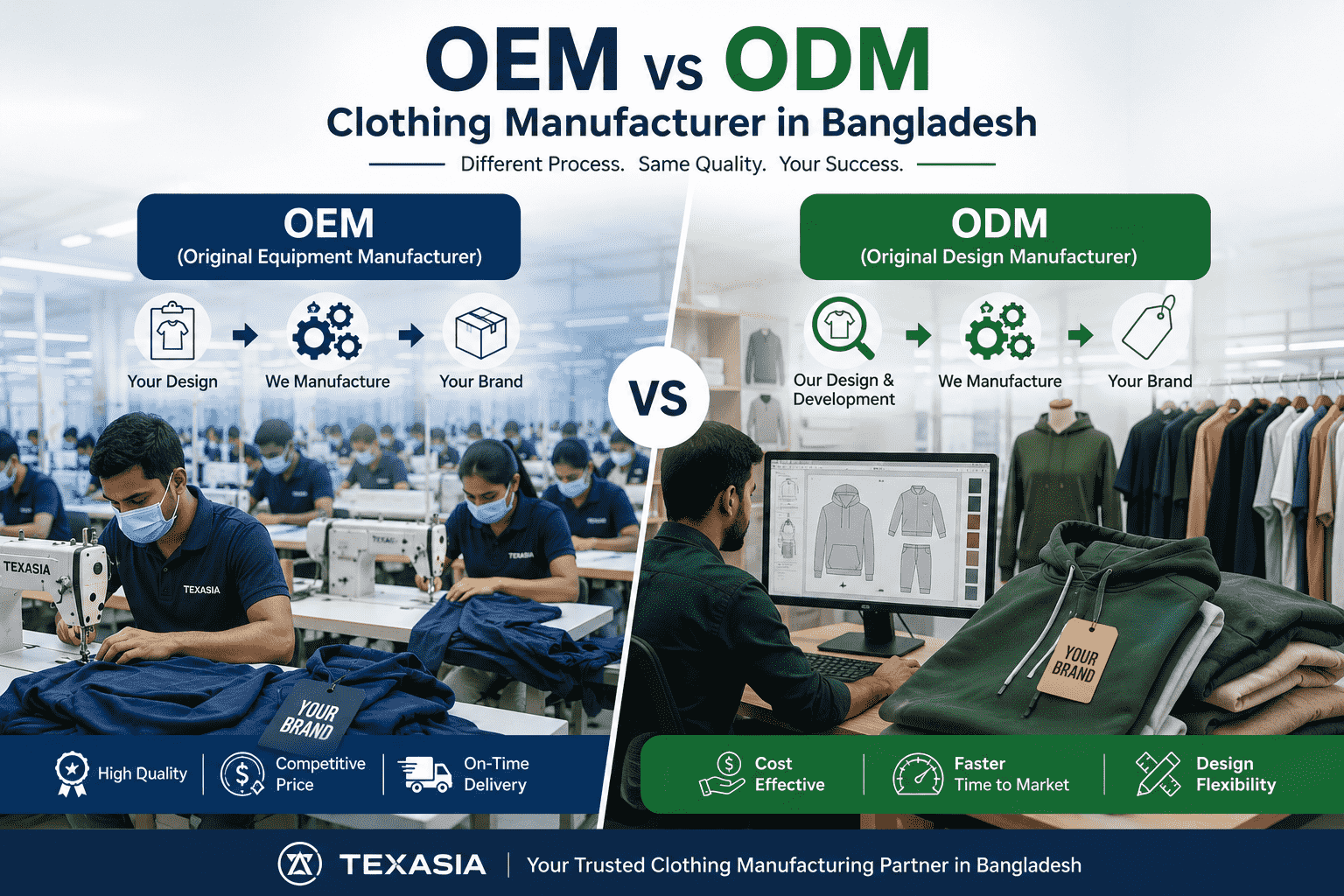
Bangladesh’s clothing manufacturing has grown fast over the past decade. Many international buyers now choose Bangladesh for bulk apparel production. The country offers low cost and strong factory capacity. Buyers from the USA, UK, Europe, and Australia trust Bangladesh factories for quality output.
A common question among new buyers is the difference between the OEM clothing manufacturer in Bangladesh and the ODM clothing supplier in Bangladesh. Many brands confuse the two terms early on. This confusion often leads to wrong sourcing choices. Choosing the wrong model can raise costs and delay launch dates.
Picture a small fashion brand ready to place its first order. The owner is unsure which production model fits best. Without clear guidance, brands often waste money on the wrong samples. Poor choices also affect fabric quality and delivery timelines.
This guide focuses on Texasia International Fashion Co., Ltd., a trusted custom apparel manufacturer that Bangladesh brands rely on. Texasia supports both OEM and ODM production models for global buyers. Understanding these options early saves time, money, and effort.
What Is OEM Clothing Manufacturing in Bangladesh
OEM clothing manufacturer Bangladesh partners produce garments tailored to the buyer’s design. The brand controls every detail from concept to final product. The factory follows exact instructions without changing the design. This model works well for brands wanting full ownership.
How OEM Clothing Production Works
In OEM production, the buyer develops the original design. The manufacturer then produces garments strictly based on that design. Tech packs guide fabric choice, stitching style, and measurements. Branding, labels, and packaging fully comply with the buyer’s specifications.
For example, a European fashion brand designs a new hoodie style. The brand sends the tech pack to a factory in Bangladesh. The factory develops samples based on those exact instructions. Once approved, the factory begins full bulk production immediately.
OEM Clothing Manufacturing Process Step by Step
The OEM process begins with a design submission from the buyer. Next, the factory reviews the tech pack carefully for accuracy. Fabric sourcing follows, matching the exact material listed in specs. Sampling comes next to test fit and construction quality.
After sample approval, the factory begins mass production. Quality inspection happens before packing and final shipment preparation. Common challenges include fabric delays, fit revisions, and errors in shipping documentation. Clear communication reduces most of these production risks.
What Is ODM Clothing Manufacturing in Bangladesh
ODM clothing supplier Bangladesh partners offer designs already developed in-house. The buyer selects from existing designs instead of creating new ones. Buyers can then request small changes to fit their brand. This model suits brands wanting a fast, simple launch.
How ODM Clothing Production Works
Under ODM, the factory presents a design catalog to buyers. Buyers choose styles that closely match their brand vision. Small modifications, such as color, fabric, or trim, are approved. Branding elements, such as tags and labels, are added later.
A new activewear startup wants a fast product launch. The brand selects existing leggings and jogger designs from Texasia. Custom labels and packaging get added to match branding needs. This saves design time and significantly reduces early-stage costs.
ODM Clothing Manufacturing Process Step by Step
The ODM process begins with selecting existing supplier designs. The buyer requests minor product modifications to meet brand needs. Sample approval follows once the modified design is finalized. Branding elements are applied during the sample confirmation stage.
Bulk production starts once branding and fit are approved. Packaging design gets finalized alongside production planning steps. This process moves faster than OEM in most cases. Fewer development steps mean quicker turnaround for the buyer.
OEM vs ODM Clothing Manufacturer in Bangladesh: Complete Comparison
Choosing between an OEM and an ODM clothing manufacturer in Bangladesh depends on brand goals. Each model offers different levels of control and cost. The table below clearly breaks down the key differences.
down the key differences clearly.
| Factor | OEM | ODM |
|---|---|---|
| Design Ownership | Full buyer ownership | Factory owns base design |
| Customization | Complete design freedom | Limited to modifications |
| Cost | Higher upfront cost | Lower starting cost |
| MOQ | Usually higher | More flexible for startups |
| Production Timeline | Longer development time | Faster turnaround |
| Brand Uniqueness | Strong and original | Shared design across buyers |
| Risk Level | Higher financial risk | Lower entry risk |
| Startup Suitability | Better for scaled brands | Ideal for new brands |
| Quality Control | Buyer sets full standards | Factory manages standards |
| Scalability | Strong long term scaling | Good for early testing |
Industry experts often suggest testing products first through ODM. Once a product proves popular, brands can shift toward OEM. This hybrid approach reduces risk while building brand identity over time. Many growing brands successfully follow this exact path.
OEM vs ODM: Which One Is Better for Different Clothing Businesses
Different business types need different production approaches. The right choice depends on budget, timeline, and brand goals. Below is a breakdown of common business types.
Best Choice for Fashion Startups
New fashion startups often benefit most from ODM production. This model requires lower investment during the early stage. Product launches happen much faster than OEM launches. Startups also need less technical design knowledge upfront.
A new Shopify clothing brand wants a quick first collection. The brand selects existing designs from a Bangladesh garment factory for startups. This approach lets the brand test market demand safely. Once sales grow, the brand can shift toward custom designs.
Best Choice for Established Fashion Brands
Established fashion brands usually prefer the OEM production model. This model allows full design control and brand uniqueness. Established labels often need strong differentiation from competitors. OEMs give brands greater control over quality standards.
A premium fashion label plans its next seasonal collection. The brand wants fully original designs for market positioning. Working with an OEM clothing manufacturer, the Bangladesh team supports that vision. Full design control helps maintain brand identity across collections.
Best Choice for Private Label Clothing Businesses
Private label businesses often benefit from a hybrid sourcing approach. Starting with ODM helps validate market demand quickly. Once a product performs well, brands shift toward OEM. This method balances low risk with strong brand growth.
A private-label clothing manufacturer and Bangladesh partner supports both stages well. Early ODM testing reduces financial risk for new products. Later, OEM production builds a stronger, more original brand identity. This hybrid path works well for growing e-commerce businesses.
OEM vs ODM Clothing Manufacturing Cost in Bangladesh
Cost differences between OEM and ODM depend on several factors. Design work, sampling, and fabric choice all affect final pricing.
OEM Manufacturing Costs
OEM production usually costs more due to the custom design work required. Pattern creation takes extra time and skilled labor. Sampling rounds also add cost before bulk approval happens. Custom fabric and trims often raise the total price further.
ODM Manufacturing Costs
ODM production tends to cost less overall. Existing designs remove the need for new pattern work. Development cost stays lower since samples already exist. Production also moves faster, reducing overall timeline expenses.
Example Cost Comparison Table
| Cost Factor | OEM | ODM |
|---|---|---|
| Design | Higher | Lower |
| Sampling | Higher | Lower |
| Speed | Slower | Faster |
Actual pricing always depends on fabric type and order size. Product complexity and finishing details also affect final cost. Buyers should request a detailed quote before confirming any order.
OEM vs ODM Clothing MOQ Requirements in Bangladesh
The minimum order quantity (MOQ) exists for good reason. Fabric mills require minimum yardage before starting production runs. Dyeing processes also need a bulk quantity for cost efficiency. Factories set MOQ to keep production runs profitable.
OEM production usually requires a higher MOQ overall. Custom fabric and trims need larger order volumes. ODM production offers a more flexible MOQ for new brands. This makes ODM a safer entry point for startups.
Questions to ask manufacturers about MOQ include the following points. Ask about the minimum quantity per color and per style. Ask whether the MOQ changes with fabric type selection. Ask if smaller trial orders are possible before scaling up.
Advantages and Disadvantages of OEM Clothing Manufacturing
Advantages of OEM
OEM gives brands complete control over every design detail. This leads to truly unique products in the market. Strong brand identity grows naturally through original designs. Long-term value builds as the brand gains recognition.
Disadvantages of OEM
OEM requires a higher upfront investment compared to other models. Development time also takes longer before production starts. Brands need stronger technical knowledge to create tech packs. This model may not suit very new businesses.
Advantages and Disadvantages of ODM Clothing Manufacturing
Advantages of ODM
ODM enables much faster product launches. Lower risk makes it suitable for beginner brands. New businesses can test the market without heavy investment. This model works well for small-scale testing.
Disadvantages of ODM
ODM offers less design uniqueness for the brand. Design ownership stays limited compared to OEM production. Similar products may appear across multiple brands. This can weaken long-term brand differentiation efforts.
How to Choose the Right Clothing Manufacturer in Bangladesh
Check Factory Production Capability
Confirm the factory strength across different garment categories. Some factories specialize in knitwear or woven garments. Others focus on denim or activewear production. Match factory strength with your product category needs.
Verify Certifications and Compliance
Certifications confirm ethical and quality production standards. Look for BSCI, WRAP, SEDEX, OEKO-TEX, and ISO certification. These standards protect worker welfare and product quality. Verified factories reduce compliance risk for international buyers.
Evaluate Sampling and Development Ability
Strong sampling shows the factory’s true production skill. Check how the factory handles revision requests. Fast, accurate sample turnaround signals a reliable partner. Technical support during sampling also matters greatly.
Check Communication and Export Experience
Clear English communication prevents costly production mistakes. Ask about regular production update practices. Confirm the factory experience with international buyer requirements. Export documentation knowledge also matters for smooth shipping.
Common Mistakes Buyers Make When Choosing OEM or ODM Manufacturers
Mistake 1: Choosing Only Based on Price. The lowest price does not always mean the best value. Cheap pricing sometimes hides poor fabric or weak stitching. Always balance price with quality and reliability.
Mistake 2: Skipping Sample Testing. Some buyers skip samples early to save time. This often leads to costly bulk production errors. Sample testing protects the buyer from major losses.
Mistake 3: Ignoring Design Ownership. Buyers sometimes forget to clarify the terms of design ownership. This creates confusion later during brand scaling. Clear agreements protect brand identity from the start.
Mistake 4: Ordering Too Much Before Testing Large first orders carry heavy financial risk. Testing smaller batches first reduces the risk of losses. Scaling up should happen after proven market demand.
Real Buyer Scenarios: OEM vs ODM Decision Examples
Scenario 1: New Clothing Startup A new founder wants a fast, low-cost launch. Existing designs help test the market quickly. Recommendation: ODM production best fits this situation.
Scenario 2: Premium Fashion Brand A premium label needs fully original seasonal designs. Full control over fabric and construction matters greatly. Recommendation: OEM production suits this brand well.
Scenario 3: Growing E-commerce Brand An online brand already has steady product sales. The brand now wants a stronger design identity. Testing new styles through ODM still makes sense. Scaling proven bestsellers through OEM builds stronger branding. Recommendation: A hybrid model best fits this growth stage.
Questions to Ask a Bangladesh Clothing Manufacturer Before Production
Ask whether the factory provides both OEM and ODM services. Ask which product categories the factory specializes in. Clearly state the minimum order quantity requirements. Ask whether the factory can create samples quickly.
Ask if the factory sources fabric directly or through vendors. Ask which certifications the factory currently holds. Ask how quality control gets managed during production. Ask about realistic production lead time expectations.
Buyers researching a reliable OEM clothing manufacturer in Bangladesh can review Texasia’s OEM apparel manufacturer guide for detailed sourcing insights.
FAQ
Why is Bangladesh a leading destination for OEM clothing manufacturing
Bangladesh offers low labor cost, high factory capacity, and strong global compliance standards.
Do Bangladesh garment manufacturers offer private label services?
Yes, many factories, including Texasia, offer full private label production support.
Can Bangladesh manufacturers customize clothing designs?
Yes, factories support custom fabric, fit, branding, and packaging requests.
What types of garments are available through OEM manufacturers in Bangladesh
Common products include t-shirts, hoodies, denim, dresses, and activewear.
Which apparel products are commonly produced under ODM in Bangladesh
Basic tees, joggers, leggings, and casual wear are common ODM products.
What is the minimum order quantity for OEM clothing manufacturing in Bangladesh?
OEM MOQ is usually higher due to custom fabric and trims.
What is the MOQ for ODM apparel manufacturing
ODM offers more flexible MOQ, making it easier for new brands.
How long does OEM clothing production take in Bangladesh?
OEM production typically takes 30 to 60 days after sample approval.
How long does ODM clothing production take
ODM production usually moves faster since designs already exist.
Are Bangladesh OEM manufacturers suitable for global fashion brands
Yes, Bangladesh factories regularly serve brands across Europe, the USA, and Australia.
Conclusion
Choosing between an OEM clothing manufacturer in Bangladesh and an ODM depends on brand goals. Startups benefit from ODM speed and lower risk. Established brands gain more value through full OEM control. Texasia supports both paths for confident, informed sourcing decisions.

