
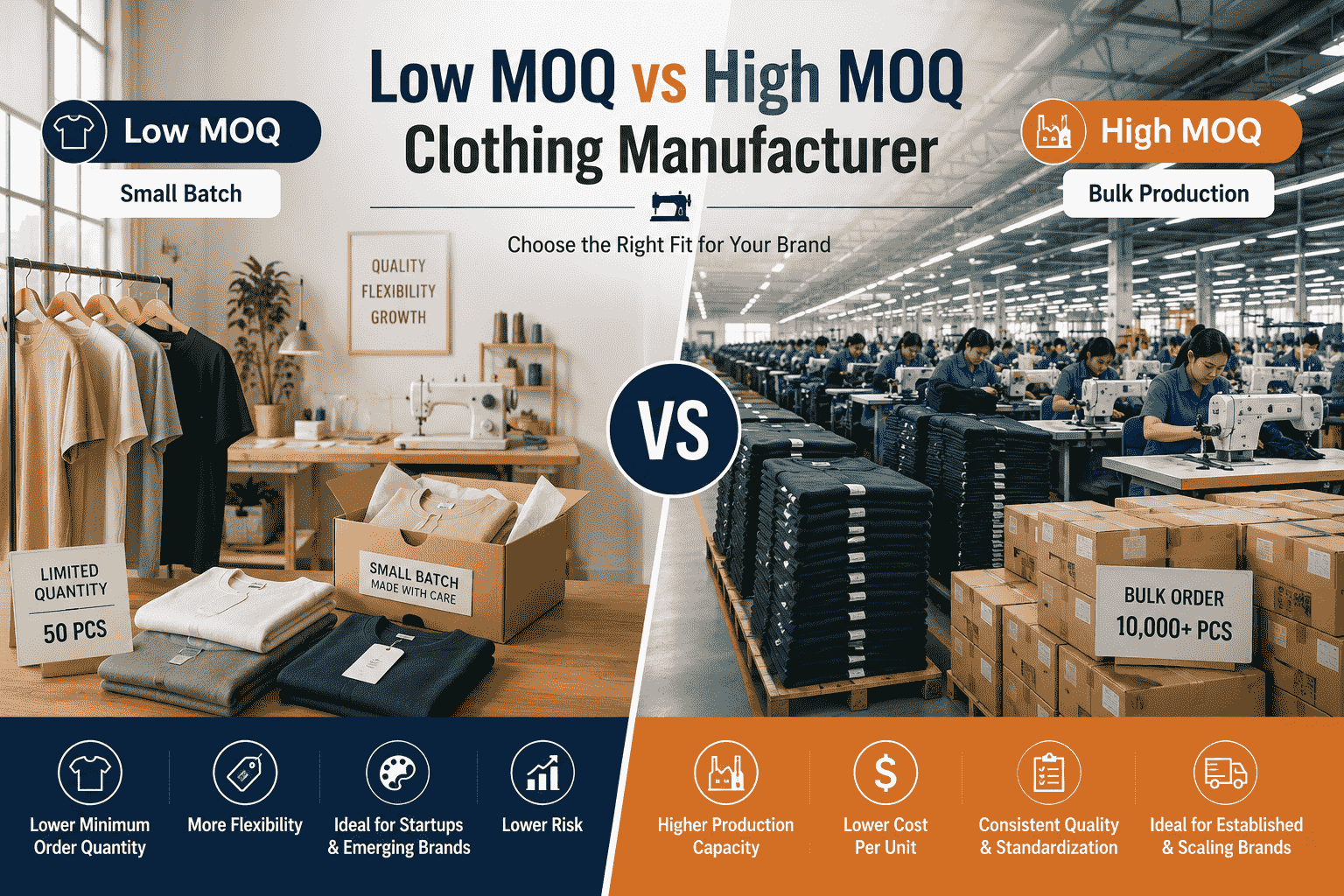
Choosing between a low MOQ and a high MOQ clothing manufacturer shapes your entire business plan. Texasia is a trusted low MOQ vs high MOQ clothing manufacturer based in Bangladesh. We operate through BSCI, SEDEX, OEKO-TEX, GOTS, and ISO compliant factories. Our team supports brands across the USA, UK, Europe, Germany, and Australia. We offer OEM, ODM, and private label manufacturing with flexible order sizes. Our product range covers t-shirts, polos, hoodies, sweatshirts, boxers, tank tops, sweat shorts, denim, and woven apparel. This guide breaks down every part of the MOQ decision in plain language.
Quick Comparison Table
| Factor | Low MOQ Manufacturer | High MOQ Manufacturer |
|---|---|---|
| Initial investment | Lower | Higher |
| Unit cost | Usually higher | Usually lower |
| Inventory risk | Lower | Higher |
| Customization | More limited | More extensive |
| Product testing | Easier | More expensive |
| Best for | Startups and testing | Established brands |
| Reordering | Flexible but capacity-dependent | Better for predictable demand |
| Profit potential | Lower margin, lower risk | Higher margin if stock sells |
These numbers are general guides, not fixed rules. MOQ conditions change by factory, fabric, color, and garment type. A small batch clothing manufacturer may lower minimums for simple styles. The same factory may raise minimums for custom dyed fabric or heavy embroidery. Always confirm the exact terms before you commit to an order.
What is the Difference Between a Low MOQ and a high MOQ Clothing Manufacturer?
What Does MOQ Mean in Clothing Manufacturing?
Minimum order quantity in clothing manufacturing is the smallest amount a factory will produce. This number can apply to each order, each style, each color, each fabric, or each size ratio. A factory offering a 100 piece minimum may need 100 pieces per color. That means three colors could push your real order to 300 pieces. Always ask exactly how the MOQ is measured before you sign anything.
What Is Considered a Low MOQ in Clothing Manufacturing?
Order sizes generally fall into a few common ranges. Micro orders sit around 20 to 50 pieces. A low MOQ clothing manufacturer often works with 50 to 300 pieces at a time. Medium volume production usually runs from 300 to 1,000 pieces. Bulk production typically starts at 1,000 pieces or more. These ranges are only examples, not fixed industry standards. Every factory sets its own limits based on machines and staff.
What Is Considered a High MOQ?
A high MOQ clothing manufacturer often requires 500 to 1,000 pieces per style. Some factories require thousands of pieces per order. This happens because fabric mills set minimum yardage requirements. Dye lots also need a set quantity to stay cost effective. Packaging suppliers may also add their own bulk minimums,. These combined limits push the true order size much higher.
Hidden MOQs Beyond Garment Production
Many brands miss the minimums that sit outside the sewing factory. Fabric mills often need a set yardage before they will weave. Dyeing houses requires a minimum batch size for each shade. Screen printing and embroidery machines both need setup minimums as well. Custom zippers, buttons, and woven labels usually carry separate order floors. Hangtags, polybags, and cartons often need bulk printing runs, too. Each hidden minimum can raise your true total quantity by a wide margin. A brand should map every supplier at a minimum before pricing a collection.
Low MOQ vs High MOQ Manufacturer Summary
The decision between a low MOQ and a high MOQ clothing manufacturer comes down to risk versus cost. Low MOQ production lowers your financial exposure and inventory risk. High MOQ production lowers unit costs when demand remains steady. The right choice depends on cash flow, sales history, and product complexity. Newer brands often start small and scale up over time.
How Does Low MOQ vs High MOQ Clothing Manufacturing Work?
The Clothing Manufacturing Process
Every order moves through a similar production path. It starts with a tech pack submission and a factory quote. Next comes fabric sourcing, pattern development, and prototype sampling. Fit corrections and size grading follow after sample approval. A pre production sample confirms every detail before bulk manufacturing starts. Quality inspection happens before the final packing and shipping stage. This process applies whether you order 100 or 10,000 pieces.
How Factories Calculate MOQ
Here is a simple example to explain the math. A brand orders three styles in two colors each. If the MOQ is 100 pieces per color, the total changes fast. The real minimum order becomes 600 garments, not 100. Always ask if the MOQ applies per style, color, fabric, or print. Some factories set the minimum per purchase order instead. Clear answers here prevent costly surprises later in production.
Why Low MOQ Clothing Costs More Per Unit
Small orders still carry the same fixed setup costs. Pattern making, sampling, and machine setup all take real time. Cutting preparation and fabric sourcing add further labor hours. Line changeover and quality control setup also cost the factory money. These fixed costs get divided across far fewer finished garments. That math is why the cost per unit of clothing manufacturing rises with small runs.
How High MOQ Reduces Unit Cost
Larger orders spread fixed costs across many more pieces. Bulk buying also brings better pricing on raw fabric. Production lines run longer without pausing for style changes. This steady flow reduces the per-garment setup cost. Bulk packaging and freight also become cheaper per unit shipped. A lower unit cost does not always mean higher total profit. Unsold stock can still wipe out any savings gained from scale.
Ex-Factory Cost vs Total Landed Cost
The factory price is only part of the real cost. Sampling charges and fabric surcharges often add to the base price. Packaging, inspection, and shipping fees raise the number further still. Customs duties and warehousing add more cost after goods arrive. Payment fees, returns, and unsold inventory also eat into margins. Always calculate total landed cost, not just the ex-factory quote.
Real World Cost Comparison
| Quantity | Unit Cost | Total Investment | Landed Cost | Expected Sell Through | Unsold Stock Value |
|---|---|---|---|---|---|
| 100 units | Higher | Lower total | Higher per unit | Often faster | Lower risk |
| 300 units | Moderate | Moderate | Moderate | Moderate | Moderate risk |
| 500 units | Lower | Higher total | Lower per unit | Slower to clear | Higher risk |
| 1,000 units | Lowest | Highest total | Lowest per unit | Slowest to clear | Highest risk |
Best Use Cases for Low MOQ and High MOQ Clothing Manufacturers
When Low MOQ Manufacturing Is the Better Choice
A small batch clothing manufacturer meets many early stageearly stage needs. First collection launches benefit from smaller, safer production runs. New product testing works well with limited quantities of garments. Limited edition drops and influencer merchandise also suit low volumes. Seasonal collections and new color testing carry less financial risk this way. Brands entering a new market can test demand before scaling. Preorder fulfillment and niche premium products also match this model. Trend based fashion moves fast, so smaller batches reduce leftover stock.
When High MOQ Manufacturing Is the Better Choice
Proven bestselling products often justify a larger production run. Retail chain orders and wholesale distribution usually require bulk quantities. Uniform production for schools or companies needs consistent large batches. Evergreen basics, corporate merchandise, and subscription clothing all fit this model. Predictable repeat demand makes a bulk apparel manufacturer the smarter partner.
When a Hybrid MOQ Strategy Works Best
Many growing brands blend both approaches. Start by producing samples to confirm fit and quality. Launch a small test batch to gauge real customer interest. Measure sales results and return rates from that batch. Reorder the styles that perform well in the market. Move proven winners into higher volume production over time. Keep experimental designs at low MOQ until demand is proven.
Decision Matrix by Business Stage
| Business Stage | Recommended Strategy |
|---|---|
| Pre-launch brand | Samples and micro batches |
| New brand | Low MOQ |
| Growing DTC brand | Hybrid MOQ |
| Wholesale ready brand | Medium to high MOQ |
| Established retailer | High MOQ |
Cash Flow and Sell-Through Considerations
Inventory exposure equals the total ordered units multiplied by the landed cost per unit. This formula shows why the sell through rate matters so much. At 50 percent sell-through, profit often shrinks or disappears completely. At 70 percent sell-through, most brands reach a safer break-even point. At 85 percent sell-through, profit margins usually start looking healthy. At 100 percent sell-through, a brand captures its full planned margin.
Pros and Cons of Low MOQ vs High MOQ Clothing Manufacturing
Advantages of Low MOQ Manufacturing
A low MOQ clothing manufacturer offers a lower initial investment. Reduced inventory exposure protects cash flow for newer brands. Faster demand validation helps you learn what actually sells. Easier design experimentation supports more creative product testing. More frequent launches keep a brand feeling fresh to customers. Lower seasonal risk also protects against unsold leftover stock. Easier entry into new markets rounds out the benefits.
Disadvantages of Low MOQ Manufacturing
Higher unit cost is the most common tradeoff here. Fabric options can feel more limited on smaller runs. Custom trims often cost more per piece at low volume. Factories may give bigger clients higher scheduling priority. Reorder timing can feel inconsistent depending on factory capacity. Scaling quickly becomes harder once demand grows fast. Color variation between small batches can also occur. Decoration choices like embroidery may be more limited, too.
Advantages of High MOQ Manufacturing
Lower unit cost is the clearest benefit of scale. Better custom fabric options open up at higher volumes. Greater trim customization becomes possible with bulk ordering power. Production runs more smoothly with fewer style changeovers. Bulk batches also show stronger color and fit consistency. Stronger margins reward brands with proven demand. Improved purchasing power helps negotiate better terms overall.
Disadvantages of High MOQ Manufacturing
Higher cash commitment ties up more working capital upfront. Greater forecasting risk means guessing wrong costs more money. Storage expenses rise when goods sit in a warehouse. Deadstock exposure increases if a style does not sell. Markdown risk can quietly erase planned profit margins. Lower flexibility makes it harder to manage rapid design changes. Quality control becomes more complex as batch sizes increase. Financial losses grow sharply when customer demand shifts suddenly.
Why the Cheapest Unit Price May Produce Less Profit
Consider two simple, hypothetical examples side by side. A 200-unit low-MOQ order sells through at 90%. A 1,000-unit high MOQ order sells through at only 55 percent. The smaller order clears fast with almost no leftover stock. The larger order leaves 450 unsold units sitting in storage. Those unsold units result in markdown losses and increased warehousing costs. Once you subtract those costs, gross profit often favors the smaller run. This shows why the Low MOQ vs High MOQ clothing manufacturer math needs real numbers, not guesses.
Set Up Steps for Choosing the Right Clothing Manufacturer
Step 1: Estimate Realistic Product Demand
Use past sales data if your brand already has some. Preorders, waitlists, and wholesale commitments all offer real signals. Email engagement and paid ad tests also predict demand. Compare your product against similar items already selling well.
Step 2: Calculate Your Maximum Landed Cost
Work backward from your planned retail or wholesale price. Subtract your target margin and any marketplace commission fees. Factor in advertising costs, returns, and fulfillment expenses too. What remains is the highest landed cost you can afford.
Step 3: Prepare a Complete Tech Pack
Include technical drawings, exact measurements, and fabric requirements. Add stitching details, color references, and instructions for label placement. List packaging needs and clearly mark print or embroidery positions. Include measurement tolerances so the factory knows your standards.
Step 4: Ask How the Factory Defines MOQ
Ask if MOQ applies per order or per individual style. Ask whether sizes and colors can be mixed freely. Check if several styles can share the same fabric. Ask if custom dyeing carries a separate minimum requirement. Confirm whether trims are included in the quoted MOQ. Ask whether reorder minimums are lower than the first-order minimums.
Step 5: Compare Quotations Fairly
Make sure every factory quotes the same fabric composition and GSM. Match construction, stitching, and decoration details across all quotes. Confirm that packaging, incoterm, inspection standard, and delivery destination align as well. Fair comparisons only work when every detail matches exactly.
Step 6: Order Samples Before Production
Request a development sample to confirm the initial concept. Follow with a fit sample and a size set sample. A pre-production sample should confirm every final detail. A shipment sample can confirm quality right before delivery.
Step 7: Run a Pilot Production Batch
Check the defect rate across the full pilot batch. Review stitch quality, measurement accuracy, and shrinkage results closely. Test colorfastness and fit consistency across different sizes. Confirm packaging accuracy and on-time delivery performance, too.
Step 8: Establish Clear Scaling Triggers
A common trigger is 70 percent sell-through within 30 days. A return rate below your target is another good signal. Stable reorder demand and profitable acquisition cost both matter. Wholesale commitments and healthy cash flow round out the list.
Step 9: Negotiate MOQ Strategically
Ask about using stock fabric already in the factory’s inventory. Reducing color options can also lower the required minimum. Sharing fabric across multiple styles helps lower total minimums. Standard trims usually cost less than fully custom hardware. Paying a slightly higher unit price can unlock lower minimums. Committing to repeat orders often earns better long-term terms. Simplifying packaging and gradually increasing quantity can also help.
Common MOQ Mistakes Clothing Brands Should Avoid
Mistake 1: Assuming MOQ Means the Entire Order
MOQ may apply per style, per color, or per fabric type.
Mistake 2: Choosing a Manufacturer Based Only on Unit Price
Quality, communication, and reliability matter just as much as price.
Mistake 3: Comparing Ex-Factory Prices Instead of Landed Costs
Freight, customs, inspection, and storage all add real extra cost.
Mistake 4: Launching Too Many SKUs
Too many styles, colors, and sizes split a single order into many small orders.
Mistake 5: Ignoring Fabric and Trim MOQs
Supplier minimums for fabric and trims can exceed the garment factory MOQ.
Mistake 6: Assuming Low MOQ Means Fast Production
Factories often give scheduling priority to their largest clients first.
Mistake 7: Ordering More Only to Receive a Discount
Extra stock brings dead inventory, markdowns, and tighter cash flow.
Mistake 8: Skipping the Pre-Production Sample
Approving bulk production without a final sample can lead to costly errors.
Mistake 9: Failing to Check Scaling Capacity
A factory built for 100 units may struggle at 10,000 units.
Mistake 10: Moving to High MOQ Too Early
Sales validation should always precede a large-volume commitment.
Mistake 11: Failing to Plan Reorders
Fabric availability, dye lot matching, and lead time all need planning.
Mistake 12: Treating MOQ as the Only Selection Factor
Also weigh quality, specialization, compliance, communication, and lead time. Payment terms, defect handling, capacity, and IP protection matter too.
Frequently Asked Questions
What is the difference between a low MOQ and a high MOQ clothing manufacturer?
A low-MOQ manufacturer accepts smaller orders at a a higher unit cost. A high-MOQ manufacturer requires larger orders but offers lower unit pricing.
Is a low MOQ clothing manufacturer better for startups?
Yes, a low MOQ clothing manufacturer lowers financial risk for new brands. It allows real market testing before a bigger investment.
Why do high MOQ clothing manufacturers offer lower prices per unit?
Bulk orders spread fixed setup costs across more garments. This scale lowers fabric, labor, and packaging costs per piece.
What is considered a low MOQ in the clothing manufacturing industry?
Low MOQ typically ranges from 50 to 300 pieces per style. Exact numbers vary by factory, fabric, and garment complexity.
When should I choose a high MOQ clothing manufacturer?
Choose high MOQ once demand is proven and steady. It works best for bestsellers, wholesale, and repeat orders.
Can low-MOQ clothing manufacturers provide custom private-label clothing?
Yes, many factories offer private label clothing manufacturer MOQ options for small brands. Custom labels, tags, and packaging are often included.
How does MOQ affect clothing production costs and profit margins?
Smaller MOQs raise unit cost but lower total upfront investment. Larger MOQs lower unit costs but increase inventory and cash risks.
Do low MOQ manufacturers offer the same quality as high MOQ manufacturers?
Quality depends on the factory, not the order size. Many low MOQ partners follow the same compliance and inspection standards.
Can I switch from a low-MOQ clothing manufacturer to a high-MOQ manufacturer as my business grows?
Yes, many brands start small and scale into larger orders. A hybrid strategy makes this transition smoother over time.
How do I choose between a low-MOQ and a high-MOQ clothing manufacturer for my brand?
Base the choice on cash flow, sales history, and product complexity. Testing new ideas favors low MOQ, while proven sellers favor high MOQ.
Conclusion
Choosing between a low-MOQ and a high-MOQ clothing manufacturer depends on your stage and goals. Low MOQ protects cash flow and supports testing. High MOQ rewards proven demand with lower unit cost. Texasia supports both paths with flexible, compliant production across Bangladesh. Explore our bulk apparel manufacturing services to plan your next production run with confidence.

