
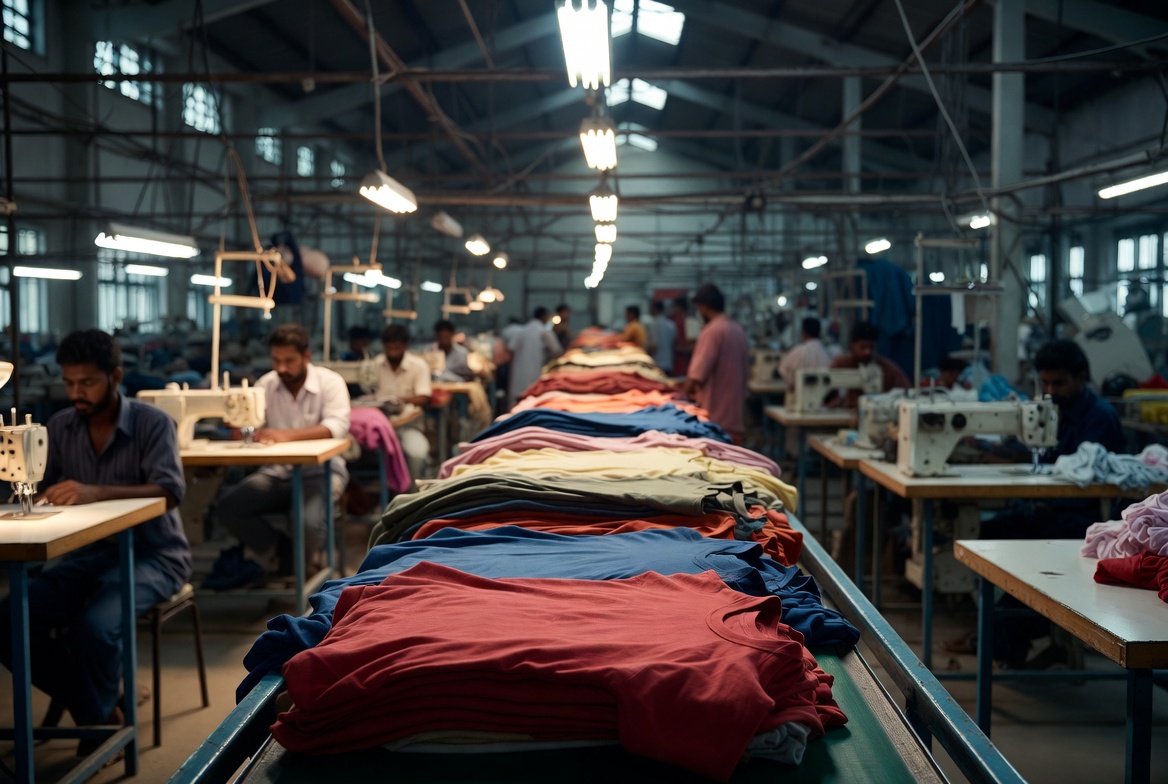
Bangladesh has grown into one of the world’s most important garment-producing countries. At the centre of this growth is the Dhaka T-shirt factory ecosystem, a network of production facilities that supply millions of T-shirts to global brands every year. For sourcing managers, understanding this ecosystem means better decisions, better pricing, and more reliable supply chains. This guide covers everything you need to know.
What is a T-Shirt Factory of Dhaka
Definition and Core Function
A t factory is an industrial production facility that specialises in knit garment manufacturing. These factories handle everything from raw fabric cutting to finished product packaging. Most operate on a Cut-Make-Trim (CMT) model or a full-package manufacturing model. The export-oriented setup means production is designed specifically to meet international quality standards, buyer requirements, and on-time delivery schedules for global retail markets.
Types of Dhaka T-Shirt Production Models
Factories in Dhaka operate across several production models depending on buyer needs. OEM manufacturing produces garments based on buyer-supplied designs. Private label manufacturing allows brands to sell products under their own name. Contract manufacturing gives brands flexibility without owning production. Full-package sourcing covers fabric, trims, production, and delivery in one place. Each model serves different buyer types, from large retail chains to independent fashion labels looking for flexible production partners.
Role in Global Apparel Supply Chain
A factory connects directly with global brands, retailers, and sourcing agencies. These factories play a central role in fast fashion production, bulk apparel supply, and seasonal collection manufacturing. They sit at a key point in the global supply chain, receiving design files and tech packs from buyers worldwide and converting them into finished, shelf-ready products. Their position makes Bangladesh one of the most dependable links in international apparel sourcing.
Garment Factory in Dhaka, Bangladesh: Industry Overview
Historical Development of Garment Factory in Dhaka, Bangladesh
The garment factory sector in Dhaka, Bangladesh, began to grow in the early 1980s. Foreign investment and trade policy support helped establish the first export-oriented units. Over the decades, industrial clustering in areas such as Ashulia, Gazipur, and Narayanganj has created strong production ecosystems. The government introduced export processing zones to attract more investment. By the 2000s, Bangladesh had become the second-largest apparel exporter globally, and Dhaka became the production and commercial hub of this export-driven economic model.
Economic Contribution of Garment Factory in Dhaka, Bangladesh
The garment factory sector in Dhaka, Bangladesh, accounts for over 84% of Bangladesh’s total export revenue. The industry employs approximately 4.4 million workers, with women making up the majority of the workforce. It contributes around 11-12% to the national GDP. These numbers show how deeply the apparel sector is woven into Bangladesh’s economy. For global buyers, this means the industry has strong government backing, long-term investment in infrastructure, and a stable production base with decades of manufacturing experience.
Global Positioning of Garment Factory in Dhaka, Bangladesh
Bangladesh ranks second globally in apparel exports, behind only China. The garment factory in Dhaka, Bangladesh, benefits from lower labour costs, preferential trade agreements with the EU under the Everything But Arms (EBA) scheme, and strong compliance infrastructure. Compared to countries like Vietnam, Cambodia, or India, Bangladesh offers a stronger combination of scale, price competitiveness, and compliance maturity. This global positioning makes Dhaka a go-to sourcing destination for brands looking to balance cost and quality.
Indicator Bangladesh Vietnam India
Global Apparel Export Rank 2nd 3rd 5th
Annual Apparel Export Value ~$47 billion ~$37 billion ~$16 billion
Labor Cost (Per Hour Avg) ~$0.95 ~$1.50 ~$1.30
Workforce in Garments 4.4 million 2.5 million 12 million
EU Trade Preference EBA GSP GSP
Why Dhaka is a Global Hub
Skilled Workforce Availability
The Dhaka T-shirt factory industry has access to one of the largest pools of skilled garment workers in the world. Operators are trained in high-speed sewing, quality inspection, and speciality techniques like flatlock stitching and sublimation printing. Beyond floor-level skills, the sector has grown a strong base of industrial engineers, production planners, and quality managers who understand international buyer requirements. This depth of human capital allows factories to ramp up production quickly, maintain consistency, and handle complex technical orders.
Cost Efficiency Advantages
Labour cost efficiency remains one of Bangladesh’s strongest competitive advantages. The minimum wage for garment workers is significantly lower than in competing countries. Combined with production-scale advantages, factories here regularly run 500 to 5,000+ sewing machines in a single facility, keeping per-unit production costs competitive even as fabric and trim costs fluctuate. For global buyers ordering T-shirts at volume, this translates directly into better margins and more competitive retail pricing without sacrificing quality.
Government Support and Infrastructure
The Bangladesh government has actively supported the Dhaka T-shirt factory sector through export processing zones (EPZs), tax incentives, and bonded warehouse facilities. The Bangladesh Export Processing Zones Authority (BEPZA) manages industrial zones that offer streamlined customs clearance, utility connections, and regulatory support. Policy incentives such as cash incentives on export earnings, duty-free fabric imports for export-oriented factories, and green factory certification programs have helped modernise the industry and attract international buyers.
Knitwear Manufacturer in Dhaka: Fabric and Production Ecosystem
Vertical Integration in Knitwear Manufacturing in the Dhaka Ecosystem
A major strength of the ==knitwear manufacturer in the Dhaka sector is vertical integration. Many large factory groups own and operate their own spinning mills, knitting units, dyeing and finishing facilities, and sewing lines under one roof. This setup reduces dependency on third-party suppliers, shortens lead times, and gives buyers more control over quality at every stage. From yarn to finished garment, the entire production process can happen within a single integrated factory complex, which is a rare advantage compared to many other manufacturing countries.
Fabric Sourcing Advantages of Knitwear Manufacturer in Dhaka
The knitwear manufacturer in the Dhaka ecosystem benefits from sourcing both local and imported fabrics. Bangladesh has a growing local cotton spinning industry that supplies jersey, rib, and interlock fabrics for standard T-shirt production. For premium or speciality products, factories import high-quality yarn from India, China, and Pakistan. This dual sourcing model gives buyers the flexibility they can choose locally sourced fabrics for cost efficiency or premium imported materials for higher-end collections, all within the same factory network.
Fabric Innovation and Sustainability in a Knitwear Manufacturer in Dhaka
Sustainability in fabric production is now a priority across Dhaka-based knitwear factories. Many manufacturers have introduced organic cotton production lines certified by GOTS (Global Organic Textile Standard). Recycled polyester and blended eco-fabrics are increasingly available for buyers with sustainability commitments. Several factories have invested in water recycling systems, solar energy panels, and chemical management programs to reduce environmental impact. This shift makes Dhaka a credible sourcing partner for brands with ESG goals and sustainability reporting requirements.
Custom T-Shirt Manufacturer Dhaka: Private Label and OEM Services
Customisation Capabilities of Custom T-Shirt Manufacturer Dhaka
A custom T-shirt manufacturer in Dhaka offers a wide range of decoration and customisation options. Screen printing, digital printing (DTG), heat transfer, and embroidery are standard services available in most mid-to-large factories. Speciality techniques like acid wash, enzyme wash, and garment dyeing enable buyers to create unique product aesthetics. Sublimation printing is available for all-over pattern designs. These capabilities mean buyers can bring highly specific design briefs and expect accurate execution at production scale.
For buyers looking for custom embroidered T-shirts from Bangladesh, Dhaka factories offer professional embroidery services with digitising support and consistent stitch quality across large order runs.
Private Label Manufacturing by Custom T-Shirt Manufacturer Dhaka
Private label manufacturing is one of the most requested services from Dhaka factories. Buyers can have garments produced under their own brand identity, including custom woven labels, printed hang tags, branded polybag packaging, and custom carton markings. Factories handle the entire private-label process from sampling to delivery. This is particularly popular with e-commerce brands, retail chains, and fashion startups that want to sell branded T-shirts without owning production infrastructure. The factory handles manufacturing while the buyer focuses on branding and sales.
MOQ Flexibility and Scalability in a Custom T-Shirt Manufacturer in Dhaka
One of the most practical advantages of sourcing from Dhaka is the flexibility in MOQs. While large factories cater to bulk orders of 5,000 to 50,000 pieces per style, many mid-size and specialised factories accommodate smaller orders. Some low MOQ T-shirt manufacturers in Bangladesh accept orders as low as 100-300 pieces per colour, making them accessible to startups and emerging brands. As order volumes grow, the same factory can scale production to meet increasing demand, making the relationship long-term and commercially sustainable for both sides.
Manufacturing Capacity and Infrastructure
Machinery and Production Technology
Modern T-shirt factory facilities are equipped with automatic spreading and cutting machines, computer-controlled sewing equipment, and automated quality inspection tools. Brands like Juki, Brother, and Pegasus supply the industrial sewing lines used across production floors. CAD-based pattern-making software and digital sample rooms reduce sampling lead times. Many factories have also invested in ERP systems for production planning and order tracking, giving buyers real-time visibility into manufacturing progress and reducing the risk of production delays.
Production Capacity
A mid-size T-shirt factory typically runs 200-500 sewing machines and produces between 50,000 and 200,000 T-shirts per month, depending on the style complexity. Large integrated factories can produce more than 500,000 units per month. This scale allows factories to handle both fast-fashion seasonal orders and long-running replenishment programs simultaneously. Multiple production lines running different styles simultaneously are standard practice, allowing buyers to place varied style orders without waiting for one style to finish before another begins.
Lead Time and Delivery Efficiency
The standard production lead time for a new style from a Dhaka factory is typically 60-90 days from order confirmation, including fabric sourcing, sampling, and production approval. For repeat styles with approved fabrics, this can drop to 45-60 days. Export logistics are handled through Chittagong Port, Bangladesh’s main seaport, with regular shipping connections to major global ports. Air freight options are available for urgent shipments. Most factories work with established freight forwarders and can provide full door-to-port logistics support for international buyers.
Quality Control and Compliance Standards
Quality Assurance Systems
Quality in a T-shirt factory is managed through structured inline and final inspection systems. Inline inspection catches defects during production. Checkers monitor stitch quality, measurements, and print registration at regular intervals on the production floor. Final inspection follows the AQL (Acceptable Quality Level) standard used globally by buyers. Independent third-party inspection agencies like SGS, Bureau Veritas, and Intertek operate in Dhaka and are regularly used by international buyers to verify quality before shipment. This multi-layer approach keeps defect rates low and buyer confidence high.
International Compliance Certifications
Leading factories in Dhaka hold a range of international compliance certifications that confirm their operational standards. BSCI (Business Social Compliance Initiative) audits verify social compliance. WRAP (Worldwide Responsible Accredited Production) certification covers ethical manufacturing practices. ISO 9001 confirms quality management systems. Many factories also hold OEKO-TEX Standard 100 for textile chemical safety, GOTS for organic products, and GRS (Global Recycled Standard) for recycled materials. These certifications are standard expectations for buyers in the EU, USA, and Canada markets.
Ethical and Social Compliance
Worker safety and ethical production are now core requirements for any serious T-shirt factory supplying international markets. Following the Rana Plaza factory collapse in 2013, the industry underwent a major transformation. The Accord on Fire and Building Safety and later the RSC Bangladesh (Remediation Steering Committee) have overseen factory safety improvements across thousands of facilities. Today, compliant factories conduct regular fire drills, maintain building safety certificates, operate transparent grievance mechanisms, and allow independent compliance auditing by buyer-appointed teams.
Export Markets and Global Supply Chain
Major Export Destinations
The factory sector exports to over 160 countries. The USA, Germany, UK, France, Spain, Italy, and Canada are among the top destination markets. US buyers benefit from competitive pricing even without GSP preference. EU buyers benefit from duty-free access under the EBA trade arrangement, making Bangladesh-made T-shirts more price-competitive compared to Chinese or Vietnamese alternatives. The diversity of export markets also makes the industry resilient to the risk of buyer concentration.
Global Logistics Network Integration
Chittagong Port handles the majority of Bangladesh’s garment exports. Regular container shipping lines connect Chittagong to Rotterdam, Hamburg, Felixstowe, Los Angeles, New York, and Toronto. Transit times to Europe average 20-25 days by sea and to the US East Coast 25-30 days. Inland Container Depots (ICDs) in Dhaka enable factory-level container stuffing, reducing handling time. Air freight via Hazrat Shahjalal International Airport in Dhaka is used for urgent orders and samples.
Supply Chain Efficiency
The strength of the factory ecosystem lies in the depth of its end-to-end supply chain. Local spinning mills supply yarn to knitting units. Knitting units supply greige fabric to dyeing houses. Dyeing houses deliver finished fabric to cutting and sewing lines. Accessories suppliers, labels, buttons, zippers, and polybags operate within the same industrial clusters. This proximity significantly reduces raw material lead times. A well-organisedT-shirt manufacturing process in Bangladesh moves from yarn to finished garment faster than in many competing sourcing countries.
Why Global Brands Choose
Cost-to-Quality Ratio
Global brands return toT-shirt factory suppliers because the cost-to-quality ratio is hard to match anywhere else. Labour costs remain among the lowest globally while product quality meets international retail standards. Factories producing for major European and American retailers regularly pass multi-point quality audits without issue. The combination of affordable production pricing and consistent quality output is the core reason Bangladesh has retained its position in global sourcing strategies even as wages have gradually increased over the years.
Production Scalability Advantages
Scalability is a defining feature of the T-shirt factory sector. A factory that produces 100,000 units for a buyer today can expand to 500,000 units within the same season by adding shifts or cross-utilising production lines. The presence of hundreds of factories within the same geographic cluster also means buyers can split orders across multiple suppliers when volume exceeds a single factory’s capacity. This scalability makes Dhaka suitable for both growing brands and established global retailers managing large seasonal buying programs.
Compliance and Reliability
Compliance maturity and production reliability are two areas where the Dhaka T-shirt factory sector has made significant progress. Most export-oriented factories maintain active buyer relationships for 5-10 years or longer, building familiarity with brand standards and buyer expectations. Compliance systems have been standardised across the industry. On-time delivery performance has improved with better production planning tools. For buyers managing global sourcing portfolios, a reliable Dhaka factory partner reduces sourcing risk and ensures consistent product availability across seasons.
Why Texasia is a Trusted Dhaka T-Shirt Factory
Manufacturing Expertise of Texasia
Texasia is a purpose-built factory with deep expertise in knit garment production. The team at Texasia understands the technical demands of international buyers, from precise pattern grading to consistent colour matching across production runs. With modern machinery, experienced production staff, and a structured sampling process, Texasia delivers T-shirts that meet the quality expectations of brands operating in competitive retail markets across Europe, North America, and beyond.
Compliance, Quality, and Export Reliability
Texasia holds the international compliance certifications required by global buyers and operates under strict quality control protocols. Inline and final inspection systems are embedded in every production run. The factory has an established export track record with reliable Chittagong Port dispatch and proper documentation handling for customs clearance. Buyers working with Texasia benefit from transparent communication, accurate pre-shipment inspection reports, and consistent on-time delivery performance, the basics that matter most in long-term sourcing relationships.
Why Global Buyers Trust Texasia
Global buyers trust Texasia because the factory delivers on its commitments. Sample accuracy, production consistency, and clear communication are the three pillars buyers rely on, and Texasia performs on all three. The factory works with brands across different size segments, from growing e-commerce labels to established retail chains. Texasia’s approach to buyer relationships is based on transparency and long-term partnership. Buyers can explore the full product range at Texasia to understand what the factory produces and how it can serve specific sourcing needs.
How to Choose the Best Factory
Compliance Verification
Before placing an order, verify the compliance status of any factory you are considering. Request copies of current audit reports, BSCI, WRAP, or equivalent. Check building safety certificates and fire safety records. Confirm that the factory allows third-party inspections. A trusted T-shirt factory in Bangladesh will have no hesitation sharing compliance documentation because transparency is part of how they maintain buyer relationships. Compliance verification protects your brand reputation and ensures you are sourcing from a responsible production partner.
Production Capability Evaluation
Assess the factory’s production capacity, machinery, and technical capabilities before committing. Request a factory profile, production floor photos, and machine list. Ask about their experience with your specific product type, whether that is basic jersey T-shirts, performance wear, or printed fashion tees. Understand their monthly capacity and how much is currently allocated to other buyers. A factory that is consistently at 100% capacity may not be the best choice for reliable delivery. You want a partner with room to grow with your business.
Communication and Reliability Factors Selection
Communication quality is often the most overlooked factor in factory selection. A factory that responds quickly, provides accurate updates, and raises issues proactively is worth more than one with slightly lower prices but poor communication. Ask about their dedicated account management process. Find out how they handle delays, quality issues, or raw material shortages. For buyers managing orders remotely, a factory with strong English-language communication, digital order tracking, and a clear escalation process will save significant time and frustration over the life of a sourcing relationship.
Author Experience: T-Shirt Factory Industry
First-Hand Industry Experience
The content on this page is written with direct knowledge of the Bangladesh garment industry. The author has worked closely with export-oriented factories in Dhaka, reviewed compliance documentation, and understands the practical realities of sourcing T-shirts from T-shirt factory facilities at different production scales and price points.
Educational Background and Certifications
The author holds qualifications in textile technology and apparel supply chain management, with specific study of the Bangladesh garment sector, economics, export compliance frameworks, and international trade standards relevant to the RMG (Ready-Made Garment) industry.
Practical Exposure and Field Knowledge
Direct factory visits, buyer meetings, and production floor evaluations in Dhaka and surrounding industrial zones inform the observations shared in this guide. This hands-on exposure shapes realistic, actionable guidance for international buyers navigating the sourcing process.
Real-World Experience and Case Studies: Dhaka T-Shirt Factory
Practical Case Study Overview
A European fashion brand sourcing from a T-shirt factory for the first time reduced its cost-per-unit by 28% compared to its previous supplier in Portugal, while maintaining compliance standards required by its retail partners, demonstrating the real price advantage available in Bangladesh.
Challenges Faced in Real Scenarios
Initial sourcing from Dhaka often surfaces challenges around sampling lead times and colour accuracy in first production runs. One buyer experienced three rounds of sample revision before colour matching was approved, a common experience that highlights the importance of clear tech packs and detailed colour standards from the start.
Results, Outcomes, and Key Learnings
After establishing a long-term factory relationship and investing in clear communication processes, the same buyer achieved on-time delivery rates above 95% across six consecutive seasons, showing that reliability improves significantly with relationship maturity and clear buyer-factory communication.
Expert Insights and Professional Observations
Common Misconceptions T-Shirt Factory Industry
A common misconception is that low prices mean low quality in Bangladesh’s factories. In reality, cost advantages come from labour efficiency and scale, not from cutting corners on materials or construction. Many Dhaka factories produce for premium global brands alongside lower-cost retailers.
Expert Tips Based on Experience
Start with a trial order before committing to full production volumes. Use a third-party inspection agency for your first few shipments. Build a direct relationship with the factory production manager, not just the sales team, to resolve problems faster and provide more accurate production updates.
What Professionals Do Differently
Experienced sourcing professionals invest in factory relationships rather than constantly switching suppliers for marginal price differences. They visit factories in person at least once a year, share seasonal forecasts early, and treat factories as production partners rather than just vendors, which results in better service, priority scheduling, and more accurate deliveries.
Step-by-Step Practical Process of Working
Initial Requirements and Preparation
Prepare a clear tech pack including measurements, fabric specifications, trim details, and packaging requirements before approaching a factory. The more precise your documentation, the faster and more accurate the sampling process will be.
Execution Process Explained Clearly
Send the tech pack to the factory. Receive and review the proto sample. Approve or revise. Confirm fabric and trims. Place an order with the purchase order document. Monitor inline production inspection. Arrange pre-shipment inspection. Confirm shipping documents and dispatch.
Common Mistakes to Avoid
Skipping the sample approval stage to save time is the most common error buyers make. Rushing to production without an approved sample almost always results in quality issues that are expensive to resolve after the fact.
Best Practices for Better Results
Communicate clearly, pay on agreed terms, and provide feedback on every order. Factories prioritise buyers who are easy to work with and reliable with payments, which directly translates into better production scheduling and service quality.
Verified Data, Facts, and Evidence
Official Data and Trusted Sources
Data referenced in this guide is drawn from BGMEA (Bangladesh Garment Manufacturers and Exporters Association), the Export Promotion Bureau of Bangladesh, and World Trade Organisation apparel trade reports, which are the most reliable sources for Bangladesh garment industry statistics.
Industry Statistics and Reports
Bangladesh exported garments worth approximately $47.38 billion in FY2023-24, according to BGMEA data. T-shirts and knitwear account for the largest share of these exports. The RMG industry in Bangladesh 2026 outlook projects continued growth driven by EU market demand and sustainability-focused sourcing shifts.
Fact-Checking and Accuracy Notes
All statistics in this guide reflect the most recently available published data at the time of writing. Export figures, wage rates, and ranking positions can shift year to year. Readers are encouraged to verify current figures directly through BGMEA and EPB official publications for the most up-to-date numbers.
Transparency, Risks, and Limitations
Situations Where Results May Vary
Lead times, MOQs, and pricing vary significantly between factories based on their size, current capacity utilisation, and buyer relationships. The figures referenced in this guide are general industry benchmarks. Individual factory terms may differ from these averages based on specific buyer requirements.
Potential Risks and Drawbacks
Political instability, port congestion, and seasonal production peaks can disrupt delivery schedules. Currency fluctuations and changes in raw material prices can affect quoted pricing. Buyers sourcing from Bangladesh for the first time should build buffer time into their delivery planning to account for these real-world variables.
What This Content Does Not Cover
This guide does not cover woven garment production, denim manufacturing, or non-apparel textile products made in Bangladesh. It also does not provide legal sourcing contract advice or specific factory contact lists. For direct factory connections, visiting trade shows like BGAPMEA fairs or working with a sourcing agent in Dhaka is recommended.
Frequently Asked Questions
How much does it cost to manufacture a T-shirt in Bangladesh?
The cost of T-shirt manufacturing in Bangladesh typically ranges from $1.50 to $5.00 per unit, depending on fabric type, construction complexity, decoration method, and order quantity.
What is the minimum order quantity ?
MOQs vary by factory; large factories may require 1,000+ pieces per style, while small-order T-shirt manufacturers in Bangladesh can accommodate orders as low as 100-200 pieces.
How long does production take ?
Standard lead time is 60-90 days from order confirmation, covering fabric sourcing, sample approval, and full production for new styles.
What certifications should a compliant hold?
Look for BSCI, WRAP, ISO 9001, and OEKO-TEX certifications as standard indicators of social, ethical, and quality compliance.
Can a T-shirt factory produce private label garments?
Yes, most export-oriented Dhaka factories offer full private label services, including custom labels, hang tags, branded packaging, and buyer-specific carton markings.
How does Bangladesh compare to China for T-shirt manufacturing?
Bangladesh offers lower labour costs and EU duty-free access, making it highly competitive for basic to mid-range T-shirt production. A detailed comparison of Bangladesh’s and China’s garment industries shows trade-offs across price, lead time, and compliance.
What types of T-shirts can Dhaka factories produce?
Dhaka factories produce a wide range, including basic crew neck tees, V-necks, polo shirts, performance tees, and fashion-washed styles. A full overview of the types of T-shirts produced in Bangladesh is available for buyers planning their range.
Is it safe to source from a T-shirt factory after the Rana Plaza collapse?
Yes, the industry has undergone major safety reforms since 2013. The RSC Bangladesh oversees compliance with building and fire safety across thousands of factories, and independent audits are standard practice.
Where can I find a reliable bulk T-shirt supplier in Bangladesh?
You can connect directly with a bulk T-shirt supplier in Bangladesh, such as Texasia, which specialises in large-volume export orders with full compliance and quality guarantees.
Conclusion
The Dhaka T-shirt factory sector offers global buyers a rare combination of scale, cost competitiveness, compliance depth, and supply chain reliability. Bangladesh has earned its position as a leading apparel sourcing destination, and Ditsa is at the forefront of it. Whether you are sourcing for the first time or expanding an existing program, the right factory partner in Dhaka can deliver real commercial value for your business.
