
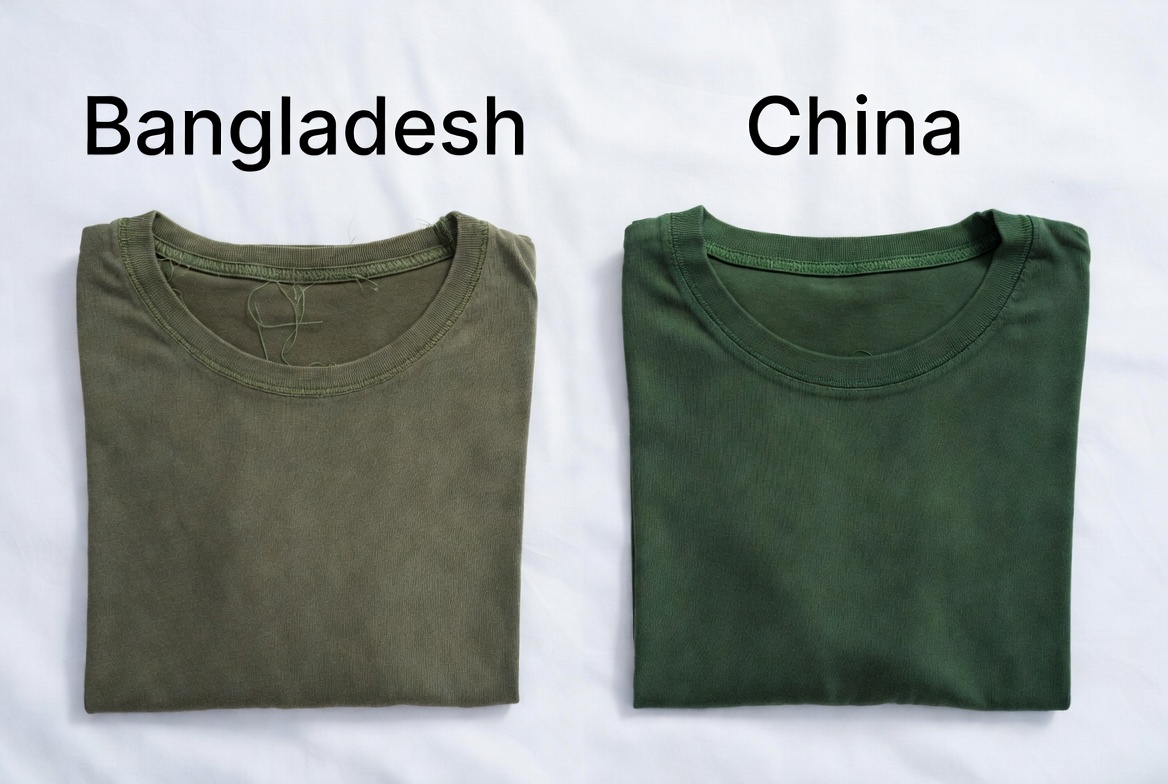
The global T-shirt market continues shifting as brands weigh production options between Asia’s top garment hubs. Bangladesh stands as the world’s second-largest garment exporter, shipping $39.35 billion worth of apparel in fiscal year 2024-2025. China maintains its position through advanced automation and vertically integrated supply chains that handle complex technical designs. The core trade-off is clear: Bangladesh excels in cost-effective, high-volume basic T-shirts with labor costs around $1.00 per hour compared to China’s $6.50, while China leads in technology-driven precision for premium styles. Both countries serve distinct market segments, with Bangladesh offering 30-50% lower production costs and preferential trade access to EU markets, while China provides faster sampling and superior fabric innovation capabilities. Among top-tier Bangladeshi suppliers, Texasia has emerged as a leading manufacturer combining modern equipment, international certifications, and competitive minimum order quantities starting from 500 pieces.

| Metric | Bangladesh | China |
|---|---|---|
| Labor Cost (per hour) | $1.00 | $6.50 |
| Typical MOQ | 1,000+ pcs | 100-500 pcs |
| Production Lead Time | 15-30 days | 10-20 days |
| LEED Green Factories | 273 certified | Limited data |
| Primary Strength | Cost efficiency, basic cottons | Technology, complex designs |
What Is the Bangladesh vs China Garment Manufacturing Comparison for T-Shirts?
Bangladesh offers 30–50% lower labor costs and duty-free EU access for basic cotton T-shirts; China provides superior automation and supply-chain integration.
| Factor | Bangladesh | China |
|---|---|---|
| Labor Cost Advantage | 85% lower than China ($1 vs $6.50/hour) | Higher wages push toward automation |
| Trade Benefits | Duty-free EU access, GSP+ benefits | Facing higher tariffs in multiple markets |
| Specialization | Basic knits, polo shirts, simple designs | Technical fabrics, performance wear, innovation |
| Factory Scale | Large export-focused units (1,000+ workers) | Variable; extensive small-to-large operations |
| MOQ Flexibility | Higher (1,000-5,000 pcs typical) | More flexible (100-1,000 pcs) |
Scale and Capacity in Bangladesh Garment Manufacturing
Bangladesh operates over 4,500 export-oriented garment factories with specialized focus on knitwear and woven basics. The country exported $22.98 billion in ready-made garments during July-January FY 2025-26, maintaining its position as a volume-driven production hub. Most factories run multi-floor operations with 500 to 3,000 workers per facility, creating economies of scale that drive down per-unit costs for orders exceeding 2,000 pieces. This scale advantage makes Bangladesh particularly attractive for brands placing seasonal bulk orders of basic cotton tees, promotional apparel, and retail chain programs. The concentration of knitwear expertise in industrial zones like Gazipur and Ashulia creates cluster benefits including shared infrastructure, specialized labor pools, and proximity to fabric suppliers.
Technology and Automation Levels in Bangladesh vs China
China leads globally in garment automation with 3D design software, laser cutting systems, and AI-powered quality checks. Chinese factories deploy robotic sewing assistants for consistent stitch quality and digital pattern-making that reduces sampling time to 48 hours. Bangladesh factories are upgrading equipment gradually, with government-backed loans helping mid-sized operations acquire computerized embroidery machines and automated cutting tables. The technology gap narrows in export-oriented Bangladeshi facilities that serve major European and North American brands, where investments in modern pressing equipment, inline inspection systems, and ERP software match international standards. Tier-1 Bangladeshi suppliers now use CAD software for pattern grading and barcode tracking for inventory management, though China maintains a 3-5 year advantage in adopting bleeding-edge manufacturing technologies.
Lead Times and Supply Chain Efficiency in Bangladesh Garment Production
Typical production lead times in Bangladesh range from 15-30 days depending on order complexity and quantity. A 5,000-piece T-shirt order requires approximately 20 days from cutting to final inspection, while 10,000-20,000 piece orders extend to 25 days. China offers faster turnarounds of 10-20 days for similar volumes due to better logistics infrastructure and integrated supply chains that house spinning, dyeing, and cutting under one roof. Bangladesh faces supply chain challenges including fabric import dependencies that add 7-14 days when sourcing specialized yarns or performance blends not available domestically. The country’s port congestion in Chittagong occasionally extends shipping schedules by 3-5 days during peak seasons. For brands prioritizing speed-to-market with technical fabrics, China maintains clear advantages; for cost-conscious programs with flexible timelines, Bangladesh delivers competitive lead times at significantly lower total costs.
How Does Apparel Production Quality Bangladesh and China Compare for T-Shirts?
Top-tier Bangladesh factories now match mid-tier Chinese quality for basic T-shirts after post-2013 safety reforms; China still leads in precision for complex designs.
Post-Rana Plaza Improvements in Bangladesh Apparel Quality
The 2013 Rana Plaza tragedy triggered sweeping reforms that transformed Bangladesh’s garment sector into one of the developing world’s most rigorously monitored industries. The Accord on Fire and Building Safety inspected over 2,300 factories, mandating structural reinforcements, fire suppression systems, and electrical upgrades with strict compliance deadlines. Over 90% of identified remediation work has been completed in Accord-covered facilities, according to International Labour Organization assessments. Bangladesh now maintains 273 LEED-certified green factories as of early 2026, including 115 Platinum-rated facilities representing 68 of the world’s top 100 eco-friendly garment factories. Major brands like H&M, Inditex, and Gap acknowledge these improvements and continue expanding Bangladeshi sourcing. The Remediation Coordination Cell and enhanced Department of Inspection for Factories and Establishments oversight ensure ongoing compliance through digital inspection tracking systems.
Factory Certifications Common in Bangladesh Garment Factories
Export-oriented Bangladesh T-shirt manufacturers typically hold ISO 9001, WRAP, BSCI, and SEDEX certifications. OEKO-TEX Standard 100 certification for textile safety is widespread among suppliers serving European markets, ensuring fabrics are free from harmful chemicals. GOTS (Global Organic Textile Standard) certification is available from specialized Bangladesh mills producing organic cotton T-shirts, with full farm-to-garment traceability. SA8000 social accountability certification covers worker welfare and labor practices in premium facilities. These certifications demonstrate Bangladesh’s shift from a low-cost, low-compliance market to a quality-conscious sourcing destination that meets multinational corporate social responsibility requirements. Third-party audit firms conduct quarterly inspections at certified facilities, verifying ongoing adherence to international quality and ethical standards.
Real-World Brand Experiences Sourcing T-Shirts from Bangladesh
Multiple international brands successfully produce 100% organic cotton T-shirts in Bangladesh with GOTS and OEKO-TEX certifications, achieving premium 180 GSM weight and durable twin-needle construction. Fair Wear Foundation-audited Dhaka factories deliver consistent quality for emerging designer labels focusing on sustainable basics. Brands report that working with vetted Bangladeshi suppliers yields quality comparable to mid-tier Chinese production at 35-45% lower landed costs. Challenges include longer sampling periods (7-10 days versus China’s 3-4 days) and occasional communication gaps that require on-ground sourcing agents. Buyers emphasize the importance of factory visits and pre-production approval samples to ensure specifications are properly interpreted. The consensus among experienced sourcing managers is that the top 20% of Bangladesh factories match or exceed mid-tier Chinese quality for basic T-shirt constructions, while China maintains advantages for technical performance wear and highly complex designs.
What Are Bangladesh T-Shirt Fabric Quality Standards Compared to China?
Bangladesh excels in affordable 100% cotton and basic blends with OEKO-TEX and GOTS options; China offers wider variety of performance fabrics and tighter shrinkage/colorfastness consistency.
Common Fabrics and Sourcing Practices in Bangladesh T-Shirt Production
100% ring-spun cotton dominates Bangladesh T-shirt production, with typical weights ranging from 150 GSM for economy tees to 200 GSM for premium basics. Cotton-polyester blends (60/40 and 50/50 ratios) are widely available for wrinkle-resistant styles. Organic cotton with GOTS certification is sourced through specialized mills offering farm-to-fabric traceability and biological effluent treatment plants. Bangladesh mills excel in single jersey and pique knits, with some facilities producing French terry and fleece for hoodies. The country imports specialized performance fabrics like moisture-wicking polyester and bamboo blends, adding 10-15% to material costs and 7-10 days to lead times. Most export-oriented factories maintain relationships with OEKO-TEX certified textile mills ensuring chemical safety compliance. Fabric testing for GSM tolerance, color consistency, and dimensional stability is standard practice at ISO-certified Bangladesh facilities.
Lab Testing Standards Used by Bangladesh T-Shirt Suppliers
AQL (Acceptable Quality Level) inspection protocols are standard at export-focused Bangladesh T-shirt factories, with most buyers specifying AQL 2.5 for major defects and AQL 4.0 for minor flaws. Top-tier facilities operate in-house testing labs measuring fabric weight (GSM), shrinkage after three washes, colorfastness to washing and light, pilling resistance (Martindale method), and tensile strength. OEKO-TEX testing ensures fabrics meet international limits for azo dyes, formaldehyde, and heavy metals. Third-party inspection agencies like SGS, Bureau Veritas, and Intertek conduct pre-shipment audits verifying measurement accuracy, stitch density (typically 12-14 stitches per inch for basic tees), and construction specifications. GOTS-certified organic cotton undergoes additional testing confirming organic fiber content and compliance with environmental processing standards throughout the supply chain. Bangladesh suppliers serving major retailers submit test reports for each production lot, with certificates retained for traceability.
Shrinkage, Pilling, and Color Fastness Benchmarks in Bangladesh
Well-managed Bangladesh T-shirt manufacturers achieve less than 5% shrinkage after three home washes for pre-shrunk 100% cotton knits. Cotton-polyester blends typically demonstrate 2-3% shrinkage due to synthetic fiber stability. Colorfastness to washing reaches Grade 4 (on a 1-5 scale) for quality-focused suppliers using reactive dyes and proper fixation processes. Pilling resistance for cotton jersey fabrics typically rates 3-4 (on a 1-5 scale) after 2,000 Martindale cycles, adequate for basic retail T-shirts with expected 12-month lifespan. China maintains marginally tighter tolerances (3-4% shrinkage, Grade 4-5 colorfastness) due to more consistent dyeing equipment and stricter incoming material inspections. The practical difference is minimal for basic cotton T-shirts when working with ISO-certified Bangladesh suppliers who follow standardized washing and heat-setting protocols.
How Does China Clothing Manufacturing Quality Control Compare to Bangladesh?
China has more automated in-line checks and higher baseline consistency; Bangladesh quality control is rapidly modernizing with AQL standards, third-party audits, and in-line inspections in export-oriented factories.
In-Line and Final Inspection Processes in Bangladesh T-Shirt Factories
Modern Bangladesh T-shirt factories implement multi-stage quality checkpoints starting with fabric inspection upon receipt, measuring GSM, width, and identifying defects per 100 yards. Cutting tables use spreading and alignment checks to ensure pattern accuracy before automated or manual cutting. In-line quality controllers inspect 10-15% of garments during sewing, verifying stitch quality, seam strength, and dimensional accuracy against approved samples. Final inspection occurs after pressing and folding, with AQL 2.5 sampling protocols checking measurements, stitching defects, fabric flaws, and workmanship issues across randomly selected pieces. Top-tier facilities employ one quality inspector per 30-40 operators, conducting hourly checks to catch defects early. Third-party pre-shipment inspections by SGS or Bureau Veritas add an independent verification layer, with detailed reports documenting pass/fail status against buyer specifications. This systematic approach has elevated quality consistency at leading Bangladesh suppliers to levels comparable with Chinese mid-tier factories.
Key Certifications (WRAP, BSCI, ISO 9001) in Bangladesh Garment Industry
ISO 9001 quality management certification is nearly universal among Bangladesh export factories, demonstrating documented processes for controlling production quality. WRAP (Worldwide Responsible Accredited Production) certification covers social compliance, verifying fair labor practices and safe working conditions. BSCI (Business Social Compliance Initiative) audits assess working hours, wages, health and safety, and environmental practices. Over 200 Bangladesh garment facilities hold LEED (Leadership in Energy and Environmental Design) certifications, with 115 achieving Platinum status for green building design and energy efficiency. SEDEX membership provides ethical trade data sharing, allowing buyers to review audit results from multiple brands. SA8000 certification for social accountability appears at premium Bangladesh facilities committed to living wages and worker welfare. These certifications create accountability frameworks that drive continuous improvement in both product quality and working conditions.
Common Quality Issues and Mitigation Strategies in Bangladesh
Measurement variation and inconsistent sizing remain the most frequently cited quality challenges when sourcing from lower-tier Bangladesh factories. Mitigation involves providing detailed tech packs with tolerance ranges (typically +/- 1 cm for body measurements) and conducting pre-production meetings to review samples. Stitch quality issues including skipped stitches, uneven seams, and loose threads are addressed through operator training programs and increased in-line inspection frequency. Color shading between production lots occurs when fabric arrives from different dye batches; top suppliers conduct lab dips and require mill shade cards before cutting. Fabric defects like holes, slubs, and dye spots are minimized through rigorous incoming material inspection using four-point systems. Communication gaps between buyers and factories can lead to specification misinterpretation; experienced buyers work with local sourcing agents who provide on-ground oversight and cultural translation. The quality gap between top-tier and mid-tier Bangladesh factories is significant, making supplier vetting and relationship building critical for consistent results.
What Is the Cost vs Quality Balance in Bangladesh and China Apparel Industry?
Bangladesh delivers 20–35% lower landed costs for basic T-shirts with acceptable-to-excellent quality when working with audited suppliers; China suits higher-margin, technical, or very small-run orders.
| Cost Component | Bangladesh (1,000 pcs) | China (1,000 pcs) | Difference |
|---|---|---|---|
| Labor per Unit | $0.50-0.80 | $1.20-1.80 | 50-60% lower |
| Fabric (180 GSM cotton) | $1.80-2.20 | $2.00-2.50 | 10-15% lower |
| Trim & Packaging | $0.30-0.50 | $0.40-0.60 | 20-25% lower |
| Factory Overhead | $0.40-0.60 | $0.70-1.00 | 35-40% lower |
| Total FOB Cost | $3.00-4.10 | $4.30-5.90 | 30-35% lower |
| Duty to USA (MFN) | 16.5% | 16.5% | Equal |
| Duty to EU | 0% (GSP) | 12% | Significant advantage |
Labor Cost and Minimum Order Quantity Differences in Bangladesh
Bangladesh garment workers earn approximately $1.00 per hour compared to $6.50 in China, creating fundamental cost advantages for labor-intensive T-shirt production. This translates to $0.50-0.80 labor cost per basic T-shirt versus $1.20-1.80 in China. Minimum order quantities in Bangladesh typically start at 1,000-2,000 pieces per style/color due to factory efficiency models optimized for bulk production. Some progressive Bangladesh suppliers now offer 500-piece MOQs for basic styles, though per-unit costs increase 15-20% at lower volumes. China provides more flexibility with 100-500 piece minimums, appealing to startups and small brands testing designs. The MOQ difference reflects infrastructure variations: Chinese factories invest in quick-changeover equipment supporting smaller runs, while Bangladesh facilities maximize efficiency through longer production runs of standardized styles. Brands placing seasonal orders exceeding 5,000 pieces per style find Bangladesh’s MOQ structure aligned with their volume requirements.
Total Landed Cost Breakdown for T-Shirts from Bangladesh
Calculating total landed cost requires factoring production, logistics, duties, and quality-related expenses. A 10,000-piece order of basic 180 GSM cotton T-shirts from Bangladesh costs approximately $3.50 FOB (Free On Board), including $0.70 labor, $2.00 fabric, $0.40 trims, and $0.40 overhead. Shipping via ocean freight to the US East Coast adds $0.35-0.50 per unit (depending on consolidation). US import duty of 16.5% on the FOB value adds $0.58, bringing landed cost to approximately $4.40-4.60 before customs clearance and domestic logistics. European Union imports from Bangladesh enjoy duty-free access under GSP+ agreements, reducing landed costs by $0.42 per unit compared to Chinese goods facing 12% duties. Quality-related costs include pre-shipment inspection ($300-500 per order) and potential rework (budget 2-3% for acceptable defect rates), adding $0.05-0.08 per unit. Total landed cost for Bangladesh T-shirts to US markets ranges $4.50-4.75 versus $5.80-6.40 for equivalent Chinese production.
When to Choose Bangladesh Over China for Your T-Shirt Order
Select Bangladesh for cost-sensitive basic cotton T-shirts in volumes exceeding 1,000 pieces per style where 25-35% cost savings justify slightly longer lead times. Bangladesh excels for retail programs, promotional apparel, uniform contracts, and private label basics where specifications are standardized and technical complexity is minimal. Choose Bangladesh when targeting European markets to maximize duty-free trade benefits that reduce landed costs by 10-12% compared to Chinese sources. Ethical sourcing initiatives favor Bangladesh’s LEED-certified green factories and post-Rana Plaza safety improvements that demonstrate corporate social responsibility. Opt for China when requiring technical fabrics like moisture-wicking polyester, bamboo blends, or specialized treatments (anti-microbial, UV protection) not readily available in Bangladesh. China suits small-run orders (under 500 pieces), rapid sampling (3-4 days versus 7-10 in Bangladesh), and complex multi-color designs requiring advanced printing technology. Fashion-forward brands needing frequent style changes and quick market response prefer China’s flexibility despite higher costs.
How Sustainable and Ethical Is T-Shirt Production in Bangladesh Compared to China?
Green Factory Initiatives and LEED Certifications in Bangladesh
Bangladesh leads the world with 273 LEED-certified garment factories as of early 2026, including 115 Platinum-rated facilities representing the highest environmental standards. The country achieved a record 36 new green certifications in 2025 alone, demonstrating accelerating investment in sustainable infrastructure. 68 of the world’s top 100 highest-rated eco-friendly factories are located in Bangladesh, positioning the nation as a global leader in green industrialization. LEED-certified facilities incorporate solar power systems, rainwater harvesting, biological effluent treatment plants, natural lighting, and energy-efficient HVAC systems. These green factories reduce carbon emissions by 30-40% compared to conventional facilities while cutting water consumption by 25-35% through recycling systems. China has fewer LEED-certified garment factories, though precise data is limited; its sustainability focus centers more on reducing coal dependency in textile dyeing and finishing operations. Bangladesh’s concentrated push for LEED certification creates competitive advantages when selling to environmentally conscious brands and retailers with science-based emissions targets.
Worker Welfare and Safety Standards in Bangladesh Garment Sector
Post-Rana Plaza reforms transformed Bangladesh into one of the developing world’s most regulated garment sectors. The Accord on Fire and Building Safety mandated structural assessments, fire safety systems, and electrical upgrades in over 2,300 factories with ongoing monitoring. Worker safety committees are now mandatory, giving employees formal channels to report hazards. Minimum wages increased to $113 monthly in 2023 (raised from $95), though living wage estimates suggest $226 is needed for basic family needs. Progressive factories are implementing skills training, daycare facilities, and health clinics to improve worker welfare beyond legal minimums. Fair Wear Foundation and other independent monitors conduct regular audits verifying working hours (typically 10 hours daily with overtime limits), safe building conditions, and freedom of association. China’s garment sector faces criticism for wage stagnation and limited union rights despite higher absolute wages, with worker protections varying significantly by province and factory ownership structure. Bangladesh’s transparency through international monitoring programs provides greater visibility into working conditions compared to China’s more opaque regulatory environment.
Circular Fashion and Recycling Efforts in Bangladesh
Leading Bangladesh garment factories now collect cutting waste for conversion into recycled yarn, reducing textile waste sent to landfills. GOTS-certified facilities incorporate circular economy principles by sourcing organic cotton from regenerative agriculture projects that restore soil health. Some Bangladesh manufacturers partner with European brands on take-back programs, collecting used garments for fiber recycling or down-cycling into industrial textiles. Fabric waste recycling remains limited compared to European or Japanese systems due to technological constraints and lack of established reverse logistics networks. Bangladesh Garment Manufacturers and Exporters Association has initiated pilot programs exploring chemical recycling of polyester blends and mechanical recycling of cotton waste. China invests more heavily in textile recycling technology, with several provinces operating industrial-scale fiber-to-fiber recycling plants processing post-consumer polyester and cotton. The circular fashion gap between both countries and developed markets remains significant, though Bangladesh’s LEED-certified factories demonstrate commitment to waste reduction and resource efficiency that align with circular economy principles.
Why Texasia Is One of the Best T-Shirt Suppliers in Bangladesh
Texasia operates as a certified T-shirt manufacturer in Bangladesh combining modern production facilities, international quality certifications, and competitive pricing structures tailored for European and North American brands. The company maintains ISO 9001 quality management systems and works with OEKO-TEX certified fabric suppliers ensuring chemical safety compliance. Texasia offers minimum order quantities starting from 500 pieces per style/color, making the supplier accessible for emerging brands and established companies alike. Production lead times range from 15-25 days depending on order complexity and quantity, with rush capabilities available for urgent programs. The facility produces 100% cotton, cotton-polyester blends, and GOTS-certified organic cotton T-shirts in weights from 140-220 GSM. Full traceability from fabric sourcing through finished goods provides transparency for brands requiring supply chain visibility to meet corporate sustainability commitments. Texasia serves clients across Europe and the United States with established logistics partnerships ensuring reliable shipping and customs clearance.
Quality Control Processes at Texasia in Bangladesh
Texasia implements four-stage quality inspection protocols beginning with incoming fabric testing for GSM, width, and defects per standardized measurement systems. Cutting operations undergo alignment checks ensuring pattern accuracy before production begins. In-line quality inspectors examine 10% of garments during sewing operations, identifying and correcting issues before they propagate through production batches. Final inspection follows AQL 2.5 sampling standards, with detailed measurement checks against buyer-approved samples covering chest width, body length, sleeve length, and neck opening dimensions. The facility maintains quality records for each production run including test reports, measurement data sheets, and photographic documentation supporting traceability requirements. Third-party pre-shipment inspections by SGS or Bureau Veritas are accommodated for buyers requiring independent verification. Texasia’s defect rate averages below 2% on major flaws and 3% on minor issues, meeting or exceeding international retail standards for basic T-shirt production.
Fabric Sourcing and Customization Options from Texasia in Bangladesh
Texasia sources fabrics from ISO and OEKO-TEX certified Bangladesh and international mills specializing in ring-spun cotton, combed cotton, and cotton-polyester blends. Standard fabric weights include 150 GSM for economy styles, 180 GSM for retail basics, and 200-220 GSM for premium thick tees. GOTS-certified organic cotton is available with 7-10 day extended lead times for fabric procurement and certification documentation. Custom dyeing accommodates Pantone color matching with lab dip approval processes ensuring color accuracy before bulk production. Printing capabilities include screen printing, heat transfer, and embroidery, with design support for logo placement and sizing. Neck label options range from printed labels to woven damask to tear-away tags based on brand preferences. Packaging customization includes poly-bagging, tissue wrapping, and retail-ready hanging with barcode labeling. The supplier maintains flexibility for mid-production adjustments when communicated promptly, though significant specification changes may affect agreed timelines.
Client Testimonials and Export Success of Texasia in Bangladesh
Texasia has successfully delivered T-shirt programs to European retail chains and US promotional product distributors with repeat order rates exceeding 75%. Client feedback highlights consistent sizing accuracy, reliable delivery timelines, and responsive communication during production cycles. One German sustainable fashion brand sources 100% of its organic cotton basics from Texasia, citing competitive pricing combined with GOTS certification as key decision factors. A UK workwear distributor reports defect rates below 2% across multiple 10,000+ piece orders, comparing favorably to their previous Chinese supplier while achieving 28% cost savings. US promotional product companies value Texasia’s 500-piece minimum order quantities for custom-printed corporate programs where traditional Bangladesh suppliers require 2,000+ pieces. The facility has maintained on-time delivery performance above 90% over the past three years, factoring weather-related shipping delays and occasional port congestion. Export success spans over 15 countries including Germany, UK, France, Netherlands, United States, Canada, and Australia with established logistics networks ensuring smooth customs clearance and final-mile delivery.
How to Choose the Right Bangladesh T-Shirt Supplier in 2026
Red Flags to Avoid When Sourcing from Bangladesh
Suppliers refusing factory visits or third-party audits lack transparency that responsible brands require for supply chain accountability. Extremely low pricing (30%+ below market rates) typically indicates corner-cutting on labor costs, fabric quality, or safety compliance that creates reputational risks. Absence of internationally recognized certifications (ISO 9001, WRAP, BSCI) suggests limited quality management systems and potential ethical concerns. Suppliers unable to provide verifiable client references or sample production records may lack experience with international buyers and export documentation requirements. Communication delays exceeding 24-48 hours for routine inquiries often indicate capacity issues or insufficient administrative support for managing overseas clients. Factories operating from residential buildings or unauthorized industrial spaces pose safety risks and may face closure by regulatory authorities. Reluctance to provide detailed cost breakdowns (fabric, labor, trims, overhead) prevents buyers from understanding value drivers and negotiating fairly. Suppliers pushing immediate commitments without sample approval or production planning discussions prioritize quick deals over quality partnerships.
Step-by-Step Supplier Vetting Guide for Bangladesh Factories
Begin with online research identifying 5-8 potential suppliers through directories, trade associations (BGMEA), and industry referrals. Request company profiles including production capacity, certifications, main product categories, and client lists. Conduct video factory tours examining production floors, quality control areas, fabric storage, and worker facilities before committing to in-person visits. Verify certifications through issuing organizations (ISO, WRAP, BSCI) using certificate numbers and expiration dates provided by suppliers. Request 3-5 client references from brands in your target market segment (retail, promotional, etc.) and contact them to discuss quality, communication, and reliability experiences. Place small initial sample orders (50-100 pieces) testing quality, communication, and documentation accuracy before scaling to production volumes. Schedule in-person factory visits if feasible, touring production areas, meeting management, and reviewing quality systems during standard operating hours. Conduct pre-production meetings reviewing tech packs, measurement specifications, tolerance ranges, and inspection standards to align expectations. Establish clear communication protocols including primary contacts, response time expectations, and preferred channels (email, WhatsApp, video calls) for different issue types.
Sample and Pre-Production Testing Best Practices in Bangladesh
Request fit samples in your three main sizes (S, M, L or equivalent) before approving production to verify pattern grading accuracy across size ranges. Submit detailed tech packs including flat sketches, measurement charts with tolerance ranges (+/- 1 cm typical), construction details (stitch types, seam allowances), and labeling specifications. Conduct wear testing on fit samples over 3-5 home wash cycles checking for shrinkage, color fading, seam strength, and fabric pilling before production approval. Request lab test reports for fabric specifications including GSM, shrinkage, colorfastness to washing (Grade 4 minimum), and OEKO-TEX certification if specified. Approve pre-production samples from actual production fabric (not development fabric) with final labels, trims, and packaging to confirm all specifications are implemented correctly. Conduct a pre-production meeting (virtual or in-person) reviewing approved samples, discussing timeline, confirming inspection standards, and establishing communication check-points. Arrange third-party inspection for first orders with new suppliers, budgeting $300-500 for SGS or Bureau Veritas pre-shipment audits that verify quality against approved samples. Document all approvals, specification changes, and communications in writing creating an audit trail for resolving potential disputes.
Future Trends in Bangladesh Garment Manufacturing vs China
Automation Investments and Industry 4.0 in Bangladesh
Bangladesh garment factories are gradually adopting Industry 4.0 technologies including automated cutting systems, RFID tracking, and IoT-enabled production monitoring. Government initiatives provide subsidized loans for technology upgrades helping mid-sized factories acquire computerized embroidery machines and automatic thread-trimming sewing equipment. The Bangladesh Garment Manufacturers and Exporters Association projects 15-20% productivity gains by 2028 as automation reduces dependence on manual operations prone to quality variation. Leading factories are implementing ERP (Enterprise Resource Planning) systems integrating production planning, inventory management, and quality tracking into unified platforms. Challenges include higher initial capital costs (30-50% more than conventional equipment) and the need for skilled technicians to operate and maintain advanced machinery. China maintains a 5-7 year technology adoption lead with more widespread use of automated sewing robots, AI-powered defect detection, and vertical integration from spinning through finished garments. Bangladesh’s automation trajectory focuses on selective upgrades in cutting and finishing (areas with highest quality impact) rather than full robotic sewing lines, balancing cost efficiency with quality improvements.
Impact of Global Trade Agreements on Bangladesh Exports
Bangladesh is negotiating to maintain preferential trade access to the European Union as the country graduates from Least Developed Country status, which currently provides duty-free garment exports. Loss of GSP+ benefits could add 12% duty costs on EU exports, reducing Bangladesh’s competitive advantage versus Vietnam and Cambodia. The USA does not provide duty-free access to Bangladesh garments, creating 16.5% tariff disadvantages versus African Growth and Opportunity Act beneficiaries and potential US-Vietnam trade agreements. Bangladesh is pursuing bilateral free trade agreements with Canada, Japan, and Australia to diversify market access beyond EU dependence. Regional trade agreements including RCEP (Regional Comprehensive Economic Partnership) exclude Bangladesh, benefiting competitors like Vietnam, Cambodia, and China through reduced intra-Asian tariffs. The textile industry lobbies for negotiated transition periods maintaining preferential access for 5-7 years post-graduation, allowing gradual adjustment to market-rate duties. Trade policy shifts create urgency for Bangladesh to move up the value chain beyond basic T-shirts toward higher-margin technical garments less sensitive to duty fluctuations.
Opportunities for Brands Shifting from China to Bangladesh
Brands diversifying supply chains away from China-heavy concentration find Bangladesh offers immediate capacity for basic cotton T-shirts and knitwear at significantly lower costs. The “China plus one” strategy adopted by major retailers seeks to mitigate geopolitical risks, tariff exposure, and intellectual property concerns by developing alternate Asian sources. Bangladesh’s 273 LEED-certified green factories appeal to brands with science-based emissions targets and corporate sustainability commitments requiring verified environmental performance. Ethical sourcing initiatives favor Bangladesh’s post-Rana Plaza transparency through Accord monitoring and worker safety programs that demonstrate measurable improvements. Capacity constraints remain a challenge as large-scale shifts require 12-24 months for supplier onboarding, sampling, quality validation, and production ramp-up. Bangladesh excels in basic styles where 30-40% cost savings justify accepting 5-10 day longer lead times compared to China. Technical products requiring performance fabrics, complex constructions, or rapid sampling cycles continue favoring Chinese production despite higher costs. The optimal strategy involves splitting sourcing between China (for technical/complex items) and Bangladesh (for basic high-volume programs), capturing cost benefits while managing quality and flexibility needs.
Real Case Study: Texasia Delivers Premium Organic Cotton T-Shirts for European Sustainable Fashion Brand
A Germany-based sustainable fashion brand approached Texasia in 2024 seeking a Bangladesh supplier for their core organic cotton T-shirt line previously manufactured in Portugal at premium prices. The brand required GOTS certification, 180 GSM organic ring-spun cotton, and minimum orders of 800 pieces per style across 4 sizes and 3 seasonal colors. Texasia provided factory credentials including GOTS-certified fabric sourcing, OEKO-TEX compliance documentation, and ISO 9001 quality management certification. Initial sampling took 12 days including GOTS transaction certificate processing for organic cotton traceability. The German brand conducted third-party lab testing confirming fabric weight, shrinkage below 4%, and colorfastness Grade 4+ exceeding specifications. Production of the first 3,200-piece order (800 per style/size combination) required 18 days from cutting to final inspection. Pre-shipment inspection by Bureau Veritas verified AQL 1.5 compliance with zero major defects and minor defect rate of 1.8%. Cost savings reached 42% compared to Portuguese production while maintaining equivalent quality standards and full GOTS certification for marketing claims. The partnership has expanded to 15,000+ annual units across multiple styles with 90% on-time delivery performance. Customer feedback highlights consistent sizing accuracy, responsive communication during production adjustments, and reliable quality matching approved samples across repeat orders.
Frequently Asked Questions
Which country produces better quality T-shirts Bangladesh or China in 2026
Top-tier Bangladesh factories match mid-tier Chinese quality for basic cotton T-shirts, while China leads in technical fabrics and complex designs.
What are the main cost differences between Bangladesh and China T-shirt manufacturing
Bangladesh offers 30-35% lower production costs due to $1 hourly wages versus $6.50 in China, plus duty-free EU access.
What certifications should I look for in Bangladesh T-shirt suppliers
ISO 9001, WRAP, BSCI, OEKO-TEX, and GOTS certifications indicate quality management, ethical practices, and chemical safety compliance.
What is the typical minimum order quantity for T-shirts from Bangladesh
Most Bangladesh suppliers require 1,000-2,000 pieces per style, though specialized manufacturers like Texasia offer 500-piece minimums.
How long does T-shirt production take in Bangladesh compared to China
Bangladesh requires 15-30 days versus China’s 10-20 days for similar volumes, with differences narrowing at orders exceeding 5,000 pieces.
Are Bangladesh T-shirt factories safe and ethical after Rana Plaza
Over 90% of remediation work is complete in Accord-inspected facilities; Bangladesh now has 273 LEED-certified factories demonstrating safety and sustainability.
Can Bangladesh factories produce organic cotton T-shirts with GOTS certification
Yes, GOTS-certified organic cotton T-shirts are available from specialized Bangladesh suppliers with full traceability and typical 7-10 day extended lead times.
What fabrics are commonly available from Bangladesh T-shirt manufacturers
100% ring-spun cotton, cotton-polyester blends, and organic cotton are standard; performance fabrics require import adding costs and time.
How does the quality control process work in Bangladesh garment factories
AQL 2.5 sampling with in-line inspections during production and final audits before shipment are standard at export-oriented facilities.
Should I visit Bangladesh factories before placing T-shirt orders
Factory visits verify capabilities, certifications, and working conditions for building long-term partnerships, though video tours suffice for initial assessment.
Conclusion
Bangladesh T shirt quality vs China presents a strategic choice based on your specific program requirements. Bangladesh delivers exceptional value for cost-sensitive basic cotton T-shirts through competitive labor rates, LEED-certified green factories, and post-Rana Plaza safety improvements that rival Chinese mid-tier quality. China maintains advantages in technical fabrics, automation, and rapid sampling cycles suited for premium or complex designs. Working with certified suppliers like Texasia combines Bangladesh’s cost benefits with international quality standards.

