
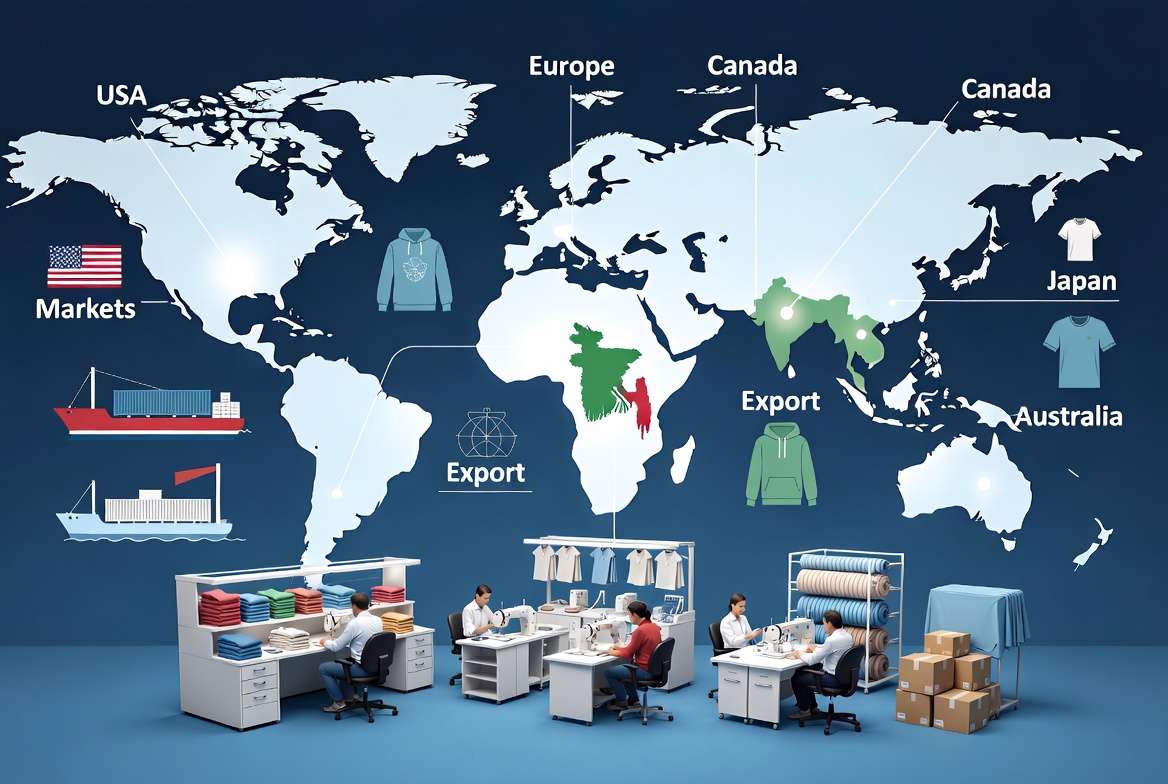
Every year, billions of knit garments leave Bangladesh and land on store shelves across the world. From soft cotton T-shirts to warm hoodies, the Bangladesh knitwear industry powers global fashion supply chains like few other countries can. This is not just a story about fabric and stitching. It is a story about millions of skilled workers, hundreds of certified factories, and decades of hard-earned buyer trust.
Bangladesh is the second-largest apparel exporter in the world. Knitwear leads the charge, making up over 50% of the country’s total garment exports. In FY 2022–23 alone, Bangladesh knitwear exports crossed a massive US$25.7 billion. That number tells you everything about the scale and strength of this sector.
Whether you are a startup brand looking for a small MOQ supplier or a large retailer placing bulk seasonal orders, the Bangladesh knitwear industry has the right factory for you. Companies like Texasia International offer full-package export services covering everything from T-shirts and polo shirts to hoodies, sweatshirts, and leggings.
This guide covers everything you need to know — the history, export data, top factories, major hubs, challenges, and future growth of the Bangladesh knitwear industry in 2026.
What Is the Bangladesh Knitwear Industry?
The Bangladesh knitwear industry is one of the biggest garment sectors in the world. It produces fabric made from interlocking yarn loops, called knitwear. This fabric is soft, stretchy, and very comfortable to wear. Bangladesh has become a top global supplier of knit garments because of its low production cost and large factory capacity.
The country exports knitwear to major markets like the European Union, the United States, and the United Kingdom. Buyers from all over the world trust Bangladesh for bulk knit garment orders. The sector plays a huge role in the national economy and creates millions of jobs for local workers.
Key Products in Bangladesh’s Knitwear Sector
Bangladesh factories produce a wide range of knit garments for global markets:
- T-shirts — the most exported knit item from Bangladesh
- Polo shirts — popular in casual and corporate wear
- Sweaters and hoodies — high-demand in cold-climate markets
- Leggings — fast-growing in the athleisure segment
- Undergarments — basic essentials produced at large scale
- Sportswear — rising demand from fitness and outdoor brands
- Children’s wear — soft knit fabrics ideal for kids’ clothing
These products reach retail shelves across 150+ countries worldwide.
History of the Knitwear Industry in Bangladesh
Bangladesh started its garment journey in the late 1970s. The knitwear segment grew quickly after the Multi-Fiber Arrangement (MFA) helped developing countries export garments with quota benefits. Local entrepreneurs built factories, learned from Korean and other Asian partners, and gradually developed a full supply chain.
By the 1990s, Bangladesh had become a recognized knitwear exporter. The backward linkage industry for yarn and fabric also grew during this time. Local spinning mills and knitting units reduced dependency on imported raw materials. This made production faster and cheaper.
The 2000s saw rapid factory expansion in areas like Narayanganj, Gazipur, and Dhaka. Bangladesh started winning orders from major global brands. BKMEA (Bangladesh Knitwear Manufacturers and Exporters Association) was established to represent the knitwear sector and help factories connect with international buyers
Role of Knitwear in Bangladesh’s RMG Sector
Knitwear is the dominant category within Bangladesh’s ready-made garment (RMG) industry. The RMG sector is Bangladesh’s largest export earner, contributing over 80% of total export revenue. Within RMG, knitwear leads ahead of woven garments in terms of export value.
The Bangladesh knitwear industry drives economic growth, creates employment for millions — especially women — and attracts significant foreign investment. It connects local yarn producers, fabric knitters, dyeing units, and garment assemblers in a strong supply chain.
History and Growth of the Bangladesh Knitwear Industry
How Bangladesh Became a Global Knitwear Exporter
Bangladesh became a global knitwear exporter through a combination of factors. Low labor costs, government export incentives, and a growing pool of skilled garment workers helped attract international buyers. The MFA quota system also gave Bangladesh an early advantage over larger exporters.
Foreign buyers shifted sourcing from higher-cost countries to Bangladesh. This created steady demand growth. Local factories invested in better machinery and more skilled staff. Over time, Bangladesh built a reputation for quality, volume, and on-time delivery in the knitwear segment.
Major Growth Milestones in the Sector
| Fiscal Year | Knitwear Export Value (USD Million) |
|---|---|
| FY 2013–14 | 12,049.81 |
| FY 2015–16 | ~13,500 |
| FY 2017–18 | ~15,800 |
| FY 2019–20 | ~14,900 (COVID impact) |
| FY 2021–22 | ~22,000 |
| FY 2022–23 | 25,738.20 |
Source: BKMEA Export Data
BKMEA reports that Bangladesh knitwear exports grew from US$12,049.81 million in FY 2013–14 to US$25,738.20 million in FY 2022–23. This shows more than double growth in under a decade. Even during the COVID-19 pandemic, the sector recovered quickly and bounced back stronger.
Bangladesh Knitwear Industry Export Performance
Knitwear Export Trends and Market Size
The Bangladesh knitwear industry has seen consistent export growth over the past ten years. Knitwear now accounts for more than 50% of Bangladesh’s total garment exports. The global demand for affordable, quality knit products keeps growing, and Bangladesh is well-placed to meet that demand.
Buyers in the EU and US continue to place large seasonal orders. The rise of fast fashion and athleisure has increased demand for stretchy, lightweight knit fabrics. Bangladesh factories are producing more of these products year after year.
Major Export Destinations for Bangladesh Knitwear
| Destination | Market Share (Approx.) |
|---|---|
| European Union | ~60% |
| United States | ~18% |
| United Kingdom | ~10% |
| Canada | ~3% |
| Other markets | ~9% |
Germany, Spain, France, Italy, and the Netherlands are the top EU buyers. In North America, major retail chains and fashion brands source heavily from Bangladesh knitwear factories. New markets in Japan, Australia, and the Middle East are also growing.
Contribution to Bangladesh’s Economy
The Bangladesh knitwear industry contributes massively to the national economy:
- Generates over US$25 billion in annual export earnings
- Employs more than 4 million workers directly in knitwear factories
- Supports millions more in related industries like yarn, accessories, and logistics
- Accounts for a large share of foreign currency reserves
- Helps fund government infrastructure and social programs
The sector is the economic backbone of Bangladesh and continues to grow each year.
Why Bangladesh Is Strong in Knitwear Manufacturing
Competitive Production Cost
Bangladesh offers some of the lowest production costs in the global apparel industry. Factory wages, land costs, and utility prices are lower than in China, Vietnam, or Turkey. This price advantage helps Bangladesh win bulk orders from cost-sensitive buyers.
For global brands managing tight margins, sourcing knitwear from Bangladesh makes strong financial sense. Even after freight and import duties, the final landed cost is usually lower than alternative sourcing countries.
Skilled Workforce and Large Production Capacity
Bangladesh has over 4,000 knitwear factories with a combined workforce of millions. Workers in Narayanganj and Gazipur are experienced in producing everything from basic T-shirts to performance sportswear. Many factories run 24-hour production shifts to meet tight delivery timelines.
Training institutes and brand-supported programs have improved technical skills across the workforce. Mid-level supervisors and quality inspectors are widely available, making it easier for factories to maintain consistent output quality.
Strong Backward Linkage in Yarn, Fabric and Accessories
One of Bangladesh’s biggest strengths is its local raw material supply chain. Local spinning mills produce cotton and polyester yarn. Knitting units convert yarn into fabric. Dyeing and finishing facilities treat the fabric before cutting and sewing.
This means factories do not have to wait weeks for imported fabric. Shorter lead times and better cost control result from this strong backward linkage network. It is one of the main reasons global buyers keep returning to Bangladesh for knitwear production.
Experience in Supplying Global Apparel Brands
Bangladesh knitwear factories have worked with global brands for over 40 years. Names like H&M, Zara, Primark, Next, C&A, Walmart, Target, and Gap have long-standing sourcing relationships with Bangladeshi factories. This experience means factories understand brand compliance requirements, quality standards, and delivery expectations.
Buyers do not need to train factories from scratch. The shared history of working with top brands makes sourcing smoother and more predictable.
Major Knitwear Manufacturing Hubs in Bangladesh
Narayanganj
Narayanganj is Bangladesh’s oldest and most established knitwear hub. It sits just south of Dhaka and has a dense concentration of knitting, dyeing, and finishing units. Many large group factories are based here. The city is known for its expertise in cotton knit fabric production.
Gazipur
Gazipur is located north of Dhaka and hosts a massive number of garment and knitwear factories. It is one of the fastest-growing industrial areas in Bangladesh. Many 100% export-oriented factories operate here, serving global buyers with large-volume orders.
Dhaka
Dhaka, the capital city, is home to hundreds of knitwear manufacturers and exporters. The city offers strong logistics connectivity, access to ports, and a wide pool of skilled labor. Many factories in Dhaka focus on premium and compliance-certified production for high-end buyers.
Chattogram
Chattogram (Chittagong) hosts Bangladesh’s main seaport, making it a key export hub. Many knitwear factories in Chattogram benefit from faster shipping access. The area also has a growing number of Export Processing Zone (EPZ) factories producing for global buyers.
Key Organizations Supporting the Bangladesh Knitwear Industry
BKMEA — Bangladesh Knitwear Manufacturers and Exporters Association
BKMEA is the primary trade body for the Bangladesh knitwear industry. It represents manufacturers and exporters, helps factories access international trade fairs, and works with the government on policy matters. BKMEA also runs a Green Industry Development cell that supports factory sustainability monitoring and eco-friendly production upgrades.
BGMEA and the Wider Apparel Industry
BGMEA (Bangladesh Garment Manufacturers and Exporters Association) represents the broader RMG sector. It promotes Bangladesh’s global apparel presence. According to BGMEA, “Made in Bangladesh” garments reach more than 150 countries around the world. BGMEA and BKMEA together form a powerful voice for the garment sector in Bangladesh.
Challenges Facing the Bangladesh Knitwear Industry
Rising Production Costs
Over the past few years, wages, energy costs, and raw material prices have gone up in Bangladesh. Factory owners have had to spend more on operations while buyers continue to push for lower prices. This creates a squeeze on profit margins, especially for smaller factories.
Energy and Utility Challenges
Factories in Bangladesh often face power shortages and gas supply issues. Many factories run their own generators to avoid production stoppages, which adds cost. The government is working on expanding power supply, but the issue still affects production schedules in some areas.
Labor Compliance and Worker Safety
After the Rana Plaza collapse in 2013, the industry faced intense scrutiny on worker safety. Since then, hundreds of factories have upgraded safety infrastructure. Compliance audits from buyers and international bodies are now regular. Maintaining high labor standards requires ongoing investment and monitoring.
Global Competition from Other Apparel Exporters
Countries like Vietnam, Cambodia, Ethiopia, and India are actively competing with Bangladesh for knitwear orders. Some offer lower wages or faster port access. Bangladesh must keep improving quality, speed, and compliance to stay ahead of these competitors.
Sustainability and Environmental Pressure
Global buyers are demanding greener production methods. Buyers want lower carbon footprints, cleaner water discharge, and reduced chemical use. Many brands have set 2030 sustainability targets that require suppliers to meet specific environmental standards. Bangladesh factories must invest in green upgrades to keep major buyer relationships.
Sustainability in Bangladesh’s Knitwear Sector
Green Factories and Eco-Friendly Manufacturing
Bangladesh is a global leader in green garment factories. The country has more LEED-certified garment factories than any other country in the world. These factories use less energy, generate less waste, and create healthier work environments. Green certification signals to buyers that a factory meets international environmental and social standards.
Water, Energy and Waste Management
Many knitwear factories have invested in effluent treatment plants (ETPs) to clean wastewater before discharge. Solar panels, energy-efficient lighting, and rainwater harvesting are becoming more common. Factories are also working to reduce fabric waste during cutting by improving pattern efficiency.
Buyer Demand for Sustainable Knitwear
Brands like H&M, Patagonia, and Marks & Spencer have strict sustainability requirements for suppliers. Bangladesh knitwear factories are responding by getting certifications like GOTS (Global Organic Textile Standard), OEKO-TEX Standard 100, WRAP, and BSCI. These certifications give buyers confidence in ethical and eco-friendly production.
Top 10 Knitwear Factories and Manufacturers in Bangladesh 2026
Here are the top knitwear manufacturers in Bangladesh known for quality, capacity, and global buyer trust:
| # | Company Name | Key Strength |
|---|---|---|
| 1 | Texasia International | Full-package knitwear export, wide product range |
| 2 | DBL Group | Large-scale vertically integrated knitwear production |
| 3 | Square Fashions Ltd. | Premium quality and compliance-focused manufacturing |
| 4 | Beximco Knitting Ltd. | Major knitwear exporter with global brand partnerships |
| 5 | Epyllion Group | T-shirt and basic knitwear specialist |
| 6 | Ananta Group | Sustainable production and strong EU buyer base |
| 7 | Envoy Textiles Ltd. | Green factory leader with strong ESG credentials |
| 8 | Knit Concern Group | High-volume knit garment production |
| 9 | Pacific Knitex Ltd. | Competitive pricing and mid-market knitwear |
| 10 | Standard Group | Diverse knitwear products for multiple markets |
Texasia International is a trusted name for buyers looking for a reliable knit garment factory Dhaka with full export capabilities. The company produces a wide range of knit products including knit T-shirts in Bangladesh, polo shirts, hoodies, sweatshirts, and tank tops.
Problems and Prospects of the Knitwear Industry in Bangladesh
Problems
The Bangladesh knitwear industry faces real pressure from multiple sides. Rising wages and energy costs are squeezing factory margins. Global competition from Vietnam and India is growing. Buyers are demanding faster delivery and lower prices at the same time. Environmental compliance costs are increasing as sustainability standards get stricter.
Worker safety remains a key concern, though the situation has improved greatly since 2013. Factories also struggle with consistent power supply, which can slow production and delay shipments.
Prospects
Despite the challenges, the prospects for the Bangladesh knitwear industry are strong. Global demand for affordable knit garments keeps growing. Bangladesh has built world-class factories with green certifications that attract top brands. The government offers export incentives that help factories stay price-competitive.
New markets in Asia, the Middle East, and Latin America are opening up. The rise of private label and ODM production is creating higher-value opportunities for Bangladeshi factories. With the right investment in technology and compliance, the sector is set for continued growth.
Future Outlook of the Bangladesh Knitwear Industry
Opportunities in High-Value Knitwear Products
Basic T-shirts and underwear will always have demand, but the real growth opportunity is in high-value knitwear. Products like performance sportswear, technical outerwear, and premium casual wear have higher margins. Bangladesh factories that can produce these categories will win more profitable orders.
Automation and Technology Adoption
Many factories are investing in automated knitting machines, digital cutting systems, and ERP software. These upgrades improve output quality and reduce per-unit cost. Automation also helps factories meet tighter production timelines without adding more labor costs.
Market Diversification Beyond Traditional Buyers
Bangladesh is actively expanding into new buyer markets. Countries like Japan, South Korea, Australia, and the UAE are becoming more important sourcing destinations. Reducing dependence on EU and US buyers protects the sector from regional demand swings.
Bangladesh’s Position in the Global Knitwear Market
Bangladesh is currently the second-largest apparel exporter in the world after China. In the knitwear segment specifically, it is a dominant global supplier. With continued investment in quality, compliance, and green production, Bangladesh is well-positioned to capture an even larger share of the global knit garment market in the coming years.
How to Choose a Knitwear Manufacturer in Bangladesh
Check Factory Certifications
Before placing an order, verify that the factory holds relevant certifications. Look for GOTS, OEKO-TEX, WRAP, BSCI, ISO 9001, or SEDEX certification. These show that the factory meets international quality, safety, and environmental standards.
Review Production Capacity
Make sure the factory can handle your order size. Ask about monthly production capacity, number of production lines, and peak season availability. A factory that is already at full capacity may not deliver on time.
Evaluate Product Quality and Compliance
Request pre-production samples before placing a bulk order. Check fabric GSM, stitching quality, color fastness, and finishing. Ask about their AQL (Acceptable Quality Level) inspection process and whether they accept third-party quality audits.
Compare Pricing, Lead Time and Export Experience
Get quotes from multiple factories and compare FOB pricing, sample lead time, and production lead time. Ask how many years of export experience the factory has and which brands they have worked with. A factory with strong export experience will handle shipping, documentation, and compliance more smoothly.
Bangladesh Knitwear Industry Overview: Key Statistics
| Indicator | Data |
|---|---|
| Total knitwear exports (FY 2022–23) | US$25,738.20 million |
| Total knitwear exports (FY 2013–14) | US$12,049.81 million |
| Growth over 10 years | ~113% |
| Share of total RMG exports | Over 50% |
| Number of knitwear factories | 4,000+ |
| Total workforce | 4 million+ |
| LEED-certified factories | World’s highest count |
| Key export markets | EU, USA, UK, Canada |
| Major knitwear hubs | Narayanganj, Gazipur, Dhaka, Chattogram |
This Bangladesh knitwear industry overview shows a sector that has grown consistently and serves major global markets with quality products at competitive prices.
FAQ
Why is Bangladesh famous for knitwear?
Bangladesh is famous for knitwear because of its low production cost, large factory capacity, skilled workforce, and strong backward linkage in yarn and fabric, making it one of the most competitive sourcing destinations in the world.
What are the main knitwear products exported from Bangladesh?
The main knitwear products exported from Bangladesh include T-shirts, polo shirts, hoodies, sweaters, leggings, sportswear, undergarments, and children’s wear, which are shipped to markets across Europe, North America, and beyond.
Who are the major buyers of Bangladesh knitwear?
The major buyers of Bangladesh knitwear include global brands like H&M, Zara, Primark, Walmart, Gap, Next, C&A, and Marks & Spencer, with the European Union and the United States being the largest importing regions.
What are the biggest challenges in Bangladesh’s knitwear sector?
The biggest challenges include rising production costs, energy shortages, global competition from countries like Vietnam and India, labor compliance requirements, and growing pressure to meet sustainability and environmental standards.
Is Bangladesh knitwear manufacturing sustainable?
Yes, Bangladesh is a world leader in green garment factory certification, with the highest number of LEED-certified factories globally, and many knitwear factories have adopted eco-friendly practices in water treatment, energy use, and waste management.
Conclusion
The Bangladesh knitwear industry is a global force in affordable, quality garment production. With strong export growth, skilled factories, and green certifications, Bangladesh continues to lead as a top sourcing destination. Buyers seeking reliable knitwear partners will find world-class options across Dhaka, Narayanganj, and Gazipur.

