
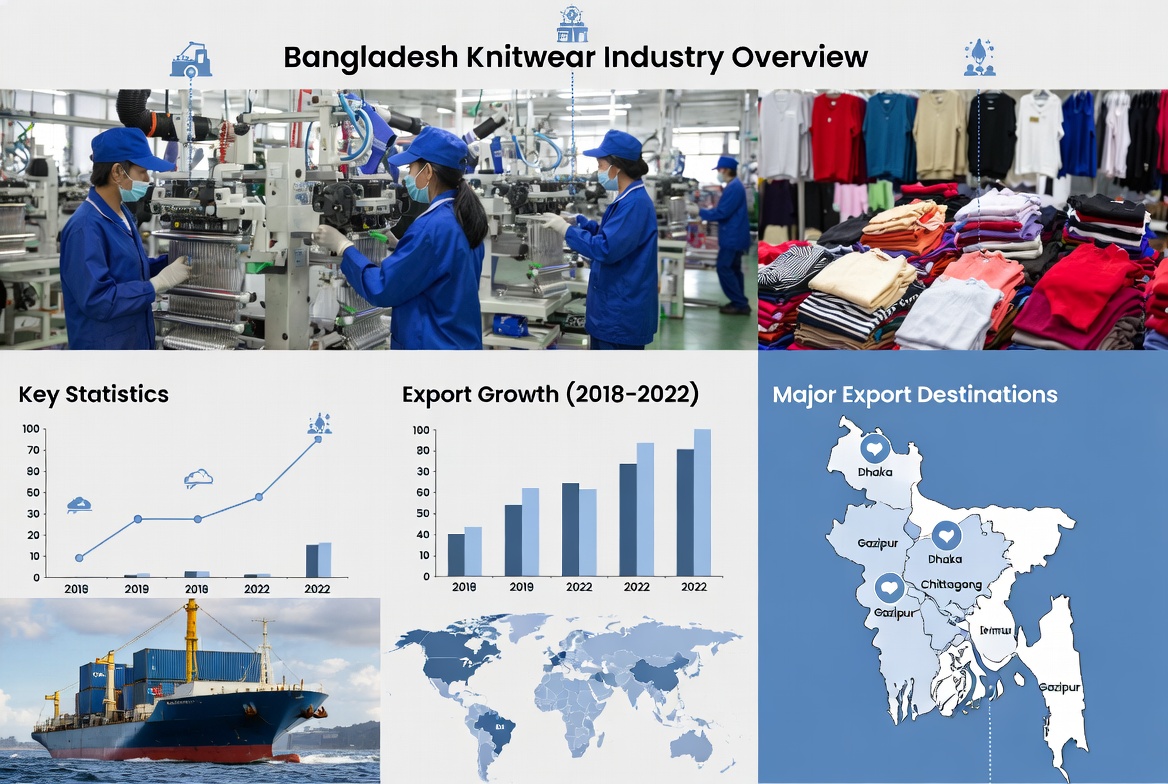
The Bangladesh knitwear industry overview is the complete picture of knitted garment production, export, and trade across the country. This sector covers products like T-shirts, polo shirts, hoodies, sweatshirts, leggings, and more. It represents one of the most active segments of the ready-made garment (RMG) sector, supplying global fashion brands with high-quality, affordable knit products at scale.
Importance of Global Apparel Market
Bangladesh holds a top-two position globally in apparel exports, and the knitwear segment drives a major share of that achievement. International brands from Europe, the USA, and Canada source heavily from Bangladeshi factories due to competitive pricing, reliable lead times, and strong manufacturing capacity. The Bangladesh knitwear industry overview shows a sector that has grown from a small export base into a multi-billion-dollar global supply chain powerhouse.
Role of Industry Overview in the National Economy
Knitwear exports contribute over 50% of Bangladesh’s total garment export earnings. The sector employs millions of workers, the majority of whom are women, making it a key driver of social development and poverty reduction. Foreign exchange earnings from knitwear directly support Bangladesh’s GDP growth and macroeconomic stability year after year.
Historical Evolution
Early Development Phase
Bangladesh’s knitwear journey started in the late 1970s and early 1980s when a few pioneering entrepreneurs set up small garment units with foreign technical support. The Desh-Daewoo collaboration in 1979 is widely credited as the turning point. That partnership trained hundreds of local workers who later launched their own factories, forming the early backbone of what is now a globally recognised knitwear manufacturing hub.
Expansion Phase (1990–2010)
Between 1990 and 2010, the Bangladesh knitwear industry underwent a dramatic shift. Factory numbers multiplied, export volumes surged, and buyers from major fashion markets started placing larger orders. The introduction of back-to-back letter of credit (LC) financing allowed factories to import yarn and accessories without heavy upfront capital. Export Processing Zones (EPZs) were established, attracting foreign investment and significantly boosting production capacity across the country.
Modern Transformation Phase
From 2010 onward, the industry entered a new era focused on compliance, sustainability, and product diversification. Following global safety concerns after 2013, factories invested heavily in structural upgrades, fire safety measures, and worker welfare programs. Today, Bangladesh is home to the world’s highest number of LEED-certified green garment factories, reflecting a deep commitment to responsible, future-ready manufacturing.
Bangladesh Knit Garment Manufacturing Sector Structure and Ecosystem
Manufacturing Infrastructure in Bangladesh Knit Garment Manufacturing Sector
The Bangladesh knit garment manufacturing sector operates through a well-developed infrastructure that includes spinning mills, knitting units, dyeing plants, cutting and sewing floors, and finishing departments. Many factories are now vertically integrated, meaning they control production from raw fibre to finished garment. This setup reduces lead times, improves quality control, and offers buyers a more streamlined sourcing experience from a single production point.
Factory Distribution and Industrial Zones in Bangladesh Knit Garment Manufacturing Sector
Most factories in the Bangladesh knit garment manufacturing sector are concentrated in Dhaka, Gazipur, Narayanganj, Chittagong, and Narsingdi. These industrial clusters benefit from shared logistics, port access, and labour availability. Special Economic Zones (SEZs) and Export Processing Zones (EPZs) offer tax benefits and infrastructure support, continuously attracting both local and foreign investment into the sector.
Compliance and Certification Standards in the Bangladesh Knit Garment Manufacturing Sector
Top factories in the sector maintain certifications including GOTS, OEKO-TEX, ISO 9001, WRAP, and BSCI. These standards ensure ethical labour practices, chemical safety, and environmental responsibility. Buyers from EU and North American markets increasingly require compliance documentation before placing orders, making certification a key factor in factory selection and long-term buyer relationships.
Role of Texasia in Bangladesh Knit Garment Manufacturing Sector Leadership
Texasia is a trusted name in Bangladesh’s knit garment manufacturing sector, known for producing high-quality knitwear that meets full compliance standards. The company serves international buyers with a wide product range, consistent quality output, and strong ethical manufacturing practices that align with global buyer expectations.
Bangladesh Knitwear Export Industry Analysis and Global Market Share
Export Growth Trend in Bangladesh Knitwear Export Industry Analysis
Over the past two decades, knitwear export values have grown from under $2 billion to over $20 billion annually. The Bangladesh knitwear export industry analysis shows a consistent upward trend driven by rising buyer confidence, improvements in product quality, and competitive pricing. Even during global disruptions like COVID-19, the sector showed resilience and bounced back faster than many competing nations.
Major Export Destinations in the Bangladesh Knitwear Export Industry Analysis
The European Union remains the largest buyer, accounting for nearly 60% of total knitwear exports. The United States is the second-biggest market, followed by the United Kingdom, Canada, and Australia. Emerging markets in Japan, South Korea, and the Middle East are also growing in importance. This geographic spread reduces over-dependence on any single market and strengthens export stability for the sector.
Competitive Advantages in the Bangladesh Knitwear Export Industry Analysis
Bangladesh offers buyers a rare combination of low production costs, a large workforce, GSP trade benefits, and strong factory compliance. These advantages make it difficult for competing countries to match Bangladesh on overall value-for-money sourcing. The country also benefits from decades of institutional knowledge in knitwear production that newer manufacturing nations cannot quickly replicate.
Bangladesh Global Ranking in the Bangladesh Knitwear Export Industry Analysis
Bangladesh ranks second globally in garment exports, after China. In the knitwear segment specifically, it holds a dominant position with a global market share of approximately 6–7%. Its share in key categories such as cotton T-shirts and knit casualwear is even higher across several EU product codes, making it a go-to sourcing destination for volume-based knitwear procurement.
Overview of Knitwear Production in Bangladesh and Manufacturing Process
Yarn Sourcing in the Overview of Knitwear Production in Bangladesh
The overview of knitwear production in Bangladesh begins with yarn. Most factories source cotton yarn domestically from local spinning mills, which helps control costs and reduce import dependency. Some speciality yarns, such as modal, viscose, and recycled polyester, are imported from China, India, and Taiwan. Yarn quality directly affects final fabric strength, colour consistency, and shrinkage performance, so buyers always verify yarn certifications.
Knitting Process in the Overview of Knitwear Production in Bangladesh
After yarn sourcing, the next step in the overview of knitwear production in Bangladesh is actual knitting. Factories use circular knitting machines to produce jersey, rib, interlock, and fleece fabrics. Modern machines from brands like Mayer & Cie and Santoni allow precise GSM control and consistent loop structure. Computer-controlled knitting has increased output speed and reduced material waste across most mid- to large factories.
Dyeing and Finishing in an Overview of Knitwear Production in Bangladesh
Fabric dyeing is done using reactive, disperse, or acid dyes, depending on fibre content. Leading factories use low-liquor-ratio dyeing machines that significantly reduce water and chemical consumption. After dyeing, fabrics go through stentering, compacting, and sanforizing to achieve dimensional stability. The finishing stage directly impacts how the garment feels and performs after washing, making it one of the most quality-sensitive steps.
Quality Control Systems in an Overview of Knitwear Production in Bangladesh
Quality control (QC) in Bangladesh knitwear factories operates at multiple stages, including fabric inspection, inline production checks, and final random audits. Many factories follow AQL 2.5 standards for defect tolerance. Buyers often engage third-party inspection agencies such as SGS, Bureau Veritas, or Intertek before shipment. Internal QC teams are now more data-driven, using digital defect-logging systems to continuously track and improve production quality.
Production Capacity and Scalability
Factory Production Capacity
The Bangladesh knitwear industr shows an impressive production capacity that can absorb both small and massive buyer orders. Large factories produce hundreds of thousands of pieces per month, while mid-sized units offer more flexible MOQs. Total industry capacity spans millions of garment units daily across thousands of active factories. This scale makes Bangladesh one of the few countries capable of efficiently handling urgent, high-volume replenishment orders.
Vertical Integration Benefits
Vertical integration is a key strength of the Bangladesh knitwear industry. When a factory controls its own spinning, knitting, dyeing, cutting, and sewing under one roof, it reduces reliance on external vendors. This means faster turnaround, better cost control, and tighter quality oversight at every stage. Buyers benefit from shorter lead times, fewer communication gaps, and more predictable delivery schedules than those from factories that outsource multiple production steps.
Role of Texasia in Bangladesh Knitwear Industry: Overview, Production Excellence
Texasia sets a strong example of production excellence in the Bangladesh knitwear . The company manages end-to-end production with skilled teams, modern machinery, and a strict quality process. From T-shirts and hoodies to polo shirts and loungewear, Texasia delivers consistently across product categories. Its production setup is designed to meet the demands of international buyers who need both quality and scale without compromising on delivery timelines.
Competitive Advantages
Cost Efficiency Advantage
Labour costs in Bangladesh remain among the lowest in the world for garment manufacturing. Combined with duty-free GSP access to EU markets, this gives buyers a significant cost edge. The Bangladesh knitwear industry shows that total landed cost from Bangladesh is often 15–30% lower than comparable production from China or Southeast Asian competitors.
Skilled Workforce Strength
Bangladesh has built a large, experienced garment workforce over four decades. Workers specialise in knitwear construction, including jersey sewing, collar attachment, and garment finishing. Technical institutes and factory training programs continuously upgrade worker skills. This depth of human capital means factories can handle complex constructions and tight tolerances that require real production expertise, not just basic sewing ability.
Strong Supply Chain
The local knitwear supply chain in Bangladesh covers yarn, fabric, trims, accessories, labels, and packaging. Most inputs are available domestically within short sourcing lead times. A well-developed backward linkage industry means factories rarely face raw material shortages. This supply chain depth is a major reason why Bangladesh can fulfil large orders quickly without the delays common in less-developed manufacturing economies.
Sustainability Adoption
Bangladesh now leads globally in LEED-certified green garment factories, with over 200 certified units and hundreds more under assessment. Many factories have adopted solar energy, rainwater harvesting, and effluent treatment plants (ETPs). Eco-conscious buyers from Europe and North America increasingly prefer Bangladesh as their sourcing partner, knowing that internationally recognised building and process certifications back sustainability commitments.
Global Competitiveness Comparison
Bangladesh vs China
China still leads globally in garment volume, but its rising labour costs and shifting trade policies have pushed buyers to explore alternatives. The Bangladesh knitwear shows that Bangladesh now captures a significant share of orders previously placed in China. Bangladesh offers 30–40% lower labour costs than China, combined with preferential trade access to EU markets that China does not enjoy. For basic and mid-range knitwear, Bangladesh is now the preferred choice for cost-sensitive buyers globally.
Bangladesh vs Vietnam
Vietnam is a strong competitor, especially in woven and synthetic garments. In the knitwear segment, Bangladesh has an edge due to its larger cotton yarn base and lower costs. Vietnam benefits from the CPTPP trade deal, giving it access to markets like Canada and Japan. The knitwear shows that both countries often serve different product segments, with Bangladesh stronger in cotton knits and Vietnam more competitive in performance and synthetic fabrics.
Bangladesh vs India
India has a massive textile industry with strong fibre production, but Bangladesh consistently outperforms in knitwear export volumes and speed to market. India’s complex tax structure and slower adoption of factory compliance have historically limited its competitiveness in export knitwear. Bangladesh factories are generally faster, better organised, and more export-oriented than their Indian counterparts in the knitwear category specifically.
Leading Manufacturers and Industry Leaders
Texasia as a Leading Knit Manufacturer
Texasia is one of the most respected knit manufacturers in Bangladesh’s knitwear industry. The company produces a full range of knitwear, including T-shirts, polo shirts, hoodies, sweatshirts, joggers, leggings, and more for international markets. With modern facilities, ethical production practices, and a buyer-focused service approach, Texasia has built a strong reputation among global brands looking for reliable, scalable knitwear sourcing from Bangladesh.
Export Reliability
Export reliability is one of the most important factors buyers evaluate when selecting a Bangladesh knitwear partner. Leading factories maintain on-time delivery rates above 90%, backed by production planning systems and buffer capacity. Bangladesh Garment Manufacturers and Exporters Association (BGMEA) also provides industry support that helps factories meet buyer deadlines. Reliable export performance has been a key reason global brands continue to deepen their sourcing in Bangladesh year after year.
Manufacturing Excellence
Manufacturing excellence in the top tier of Bangladesh knitwear factories is reflected in international audit scores, defect rates, and buyer retention. Factories that invest in lean manufacturing, digital QC tools, and worker development consistently outperform competitors on delivery and quality metrics. The Bangladesh knitwear industry clearly shows a widening gap between factory tiers, with the top performers attracting premium buyers who demand both quality and compliance.
Bangladesh Knitwear Industry , Future Trends, and Innovations
Automation Adoption
Automation is gaining ground across Bangladesh’s knitwear factories. Investments in automatic spreading machines, robotic cutting systems, and automated sewing units are reducing reliance on manual labour for repetitive tasks. While full automation is still years away at scale, semi-automated production lines are already improving output per worker. This shift is helping factories manage labour cost pressures while maintaining their price competitiveness in global markets.
Sustainability Transformation in the Bangladesh Knitwear Industry: Overview
The sustainability agenda in the Bangladesh knitwear industry is moving beyond green buildings. Factories are now adopting recycled fibre inputs, waterless dyeing technologies, and tools to track their carbon footprint. Major global brands have set net-zero sourcing targets, and Bangladeshi manufacturers are responding with real investment. Sustainable knitwear production is becoming a key differentiator for factories that want long-term contracts with premium international buyers.
Smart Factory Implementation
Smart factory concepts, including IoT sensors, real-time production dashboards, and ERP systems, are being adopted by forward-looking Bangladesh knitwear manufacturers. These tools allow factory managers to track output, monitor machine efficiency, and identify bottlenecks instantly. Data-driven production management is improving both quality consistency and worker productivity. Smart factories are also better positioned to respond to sudden order changes or urgent buyer requests with minimal disruption.
Export Market Diversification
Bangladesh is actively diversifying its export destinations beyond the EU and the USA. New focus markets include Japan, Australia, South Korea, Russia, and emerging Middle Eastern countries. Government trade missions and BGMEA-led initiatives are helping open new buyer relationships. Reducing over-reliance on two or three markets is a strategic priority that will make the Bangladesh knitwear industry more resilient against regional economic shifts or trade policy changes.
Professional Expertise and Industry Authority
First-Hand Industry Experience
Professionals writing about the Bangladesh knitwear industry draw on real factory visits, buyer meetings, and production-floor experience. This first-hand knowledge covers sourcing challenges, production realities, and buyer expectations that cannot be captured solely from secondary data. Practical experience adds depth and accuracy to industry analysis.
Educational Background and Certifications Overview
Industry experts who cover the Bangladesh knitwear industry typically hold qualifications in textile engineering, apparel merchandising, or supply chain management. Certifications from bodies like BGMEA, BTMA, or international textile institutes further validate their expertise. Academic grounding combined with field experience creates more credible, well-rounded industry knowledge.
Practical Exposure and Field Knowledge
Field knowledge in the Bangladesh knitwear industry includes understanding factory floor workflows, buyer audit processes, and compliance requirements. Professionals with direct field exposure are better equipped to evaluate factory capabilities, identify risks, and support informed sourcing decisions for international buyers.
Real-World Experience and Case Studies in the Bangladesh Knitwear Industry
Practical Case Study Overview
A mid-sized European brand shifted 30% of its knitwear orders from China to Bangladesh between 2019 and 2022. Cost savings, improved lead times, and better compliance audit results drove the move. The Bangladesh industry played a central role in informing the sourcing decision with factual industry data.
Challenges Faced in Bangladesh Knitwear Industry: Overview, Real Scenarios
In real sourcing scenarios, buyers face challenges such as mismatched minimum order quantities, communication gaps, and occasional delays during peak production seasons. The Bangladesh knitwear industry helps buyers set realistic expectations and develop contingency plans before entering supplier relationships in the country.
Results and Learnings
Brands that approached Bangladesh sourcing with clear quality benchmarks and proper factory vetting reported strong results. Key learnings include the importance of factory compliance checks, adherence to sample approval timelines, and maintaining direct communication with production teams for optimal outcomes.
Expert Insights and Professional Observations
Common Misconceptions
A common misconception is that all Bangladesh factories offer the same level of quality. In reality, there is a wide range of quality, from basic commodity producers to premium, export-focused units. The Bangladesh knitwear industry clearly shows that factory selection based on proper auditing is critical to sourcing success.
Expert Tips for Success
Experienced sourcing professionals recommend visiting factories in person, requesting compliance documents upfront, and placing a trial order before full-scale production. Understanding seasonal capacity constraints is also key. The knitwear industry provides the context needed to make smarter, more informed sourcing decisions from the start.
Professional Strategies
Top sourcing strategies include diversifying across two or three Bangladesh factories to reduce single-source risk, building long-term relationships with preferred suppliers, and participating in annual trade fairs like the Dhaka Apparel Summit to stay updated on industry developments and new factory capabilities.
Step-by-Step Practical Process in Bangladesh Knitwear Industry Overview Manufacturing
Initial Requirements Production
Buyers must prepare a tech pack with fabric specifications, construction details, and target pricing before approaching factories. Clear documentation reduces the number of sampling rounds and speeds up production approvals. Factory selection should be based on product category fit and compliance status.
Manufacturing Execution
After sample approval, factories begin bulk fabric knitting, dyeing, cutting, sewing, and finishing. Each stage follows an approved production plan. Inline inspections are conducted to catch defects early. Pre-shipment inspection confirms quality before dispatch.
Common Mistakes in Production
Common buyer mistakes include skipping factory audits, approving samples too quickly, and underestimating lead times. These errors lead to quality issues and shipment delays that could be avoided with proper pre-production planning.
Best Practices
Best practices include clear communication of quality standards, regular production updates, and building backup supplier relationships. Consistent engagement with factories leads to better service and improved product quality over time.
Verified Data, Facts, and Evidence
Bangladesh exported $47 billion worth of garments in fiscal year 2022–23, with knitwear accounting for the dominant share. The country has over 3,500 export-oriented garment factories and employs approximately 4 million workers in the sector. Bangladesh holds a 6–7% share of the global apparel market and ranks second globally in garment exports. Over 200 LEED-certified green factories operate in Bangladesh, the highest number in any single country. EU countries collectively purchase over 55% of Bangladesh’s annual knitwear output.
Official Data Sources
Key data sources include the Bangladesh Garment Manufacturers and Exporters Association (BGMEA), the Export Promotion Bureau (EPB), Bangladesh Bank, and reports from the World Trade Organisation (WTO). These institutions publish annual trade statistics, factory counts, and export breakdowns that support accurate industry analysis.
Industry Statistics
Industry statistics show consistent year-on-year export growth averaging 8–12% annually over the past decade. Knitwear categories like T-shirts, jersey tops, and fleece garments dominate export volumes. The EPB export data confirms knitwear as the single largest product category in Bangladesh’s total merchandise exports.
Fact Verification Methods
Facts in the Bangladesh industry should be cross-checked against BGMEA annual reports, EPB monthly export data, and international trade databases like UN Comtrade. Cross-referencing multiple authoritative sources ensures accuracy and reduces the risk of outdated or misleading information.
Transparency, Risks, and Limitations
Risk Factors
Key risks include political instability, labour unrest, currency fluctuations, and infrastructure bottlenecks such as port congestion. Climate-related risks such as flooding can also disrupt supply chains. Buyers should factor these risks into contingency planning when building Bangladesh sourcing strategies.
Market Limitations
Bangladesh has limited capacity in high-fashion and technical textiles. The sector is strongest in basic and mid-range cotton knitwear. For buyers needing complex fabric structures, performance materials, or very short lead times, Bangladesh may not always be the optimal single-source solution.
Scope Limitations
The Bangladesh knitwear industry overview primarily covers export-oriented manufacturing. Domestic market production, informal sector activity, and non-export-compliant factories fall outside the scope of most industry analyses. Buyers should focus evaluations on BGMEA-registered, compliance-certified factories for reliable sourcing outcomes.
FAQ
How big is Bangladesh’s knitwear export value?
Bangladesh earned over $47 billion from garment exports in 2022–23, with knitwear as the largest contributor to that total.
Which countries buy the most knitwear from Bangladesh?
The European Union, the United States, and the United Kingdom are the top three buyers of Bangladesh knitwear, collectively accounting for the majority of the total export value.
What types of knitwear does Bangladesh manufacture?
Bangladesh manufactures a wide range of products, including T-shirts, polo shirts, hoodies, sweatshirts, leggings, joggers, tank tops, and more, for global buyers.
Is the Bangladesh knitwear industry sustainable?
Yes, Bangladesh leads globally in LEED-certified green garment factories, and the industry is actively adopting eco-friendly dyeing, recycled materials, and energy-saving production processes.
Who is a reliable knitwear manufacturer in Bangladesh?
Texasia is a reliable bulk knitwear manufacturer known for high-quality production, compliance with industry standards, and on-time delivery to international buyers.
What certifications do Bangladesh knitwear factories hold?
Leading factories hold certifications such as GOTS, OEKO-TEX, ISO 9001, WRAP, and BSCI, which assure buyers of ethical and high-quality manufacturing practices.
How does Bangladesh compare to China in knitwear?
Bangladesh offers lower labour costs and GSP trade benefits for EU buyers that China does not, making it the preferred choice for sourcing cotton knitwear among cost-sensitive global brands.
What are the main production steps in Bangladesh’s knitwear industry?
The main steps are yarn sourcing, knitting, dyeing, cutting, sewing, finishing, and quality inspection, following internationally recognised production and quality control standards.
Can I order small quantities from Bangladesh knitwear factories?
Some mid-sized factories offer flexible MOQs, though larger factories typically require higher minimum quantities. Connecting with the right factory type depends on your order volume and product complexity.
Conclusion
The Bangladesh knitwear industry overview paints a clear picture of a sector that has earned its place at the centre of global fashion supply chains. With strong production capacity, competitive pricing, improving sustainability standards, and a skilled workforce, Bangladesh remains the preferred sourcing destination for knitwear buyers worldwide. For brands looking to source quality knitwear at scale, reaching out to Texasia is a strong starting point for building a reliable, long-term Bangladesh supply chain partnership.

