
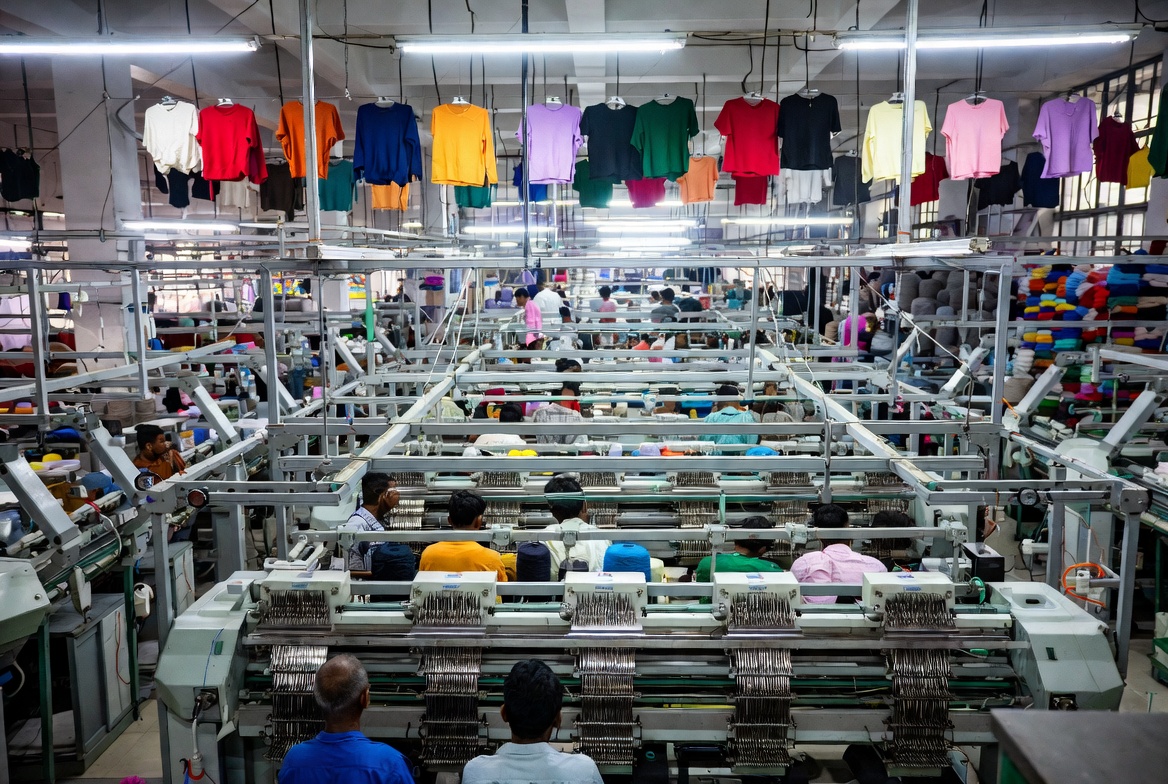
A Gazipur knitwear manufacturer is a factory in Bangladesh’s Gazipur industrial district that produces knitted garments, including t-shirts, polo shirts, hoodies, sweatshirts, leggings, and other knitwear for domestic and international markets.
Gazipur sits just north of Dhaka and is home to hundreds of RMG (Ready-Made Garment) factories. These factories operate as full-package or CMT (Cut, Make, Trim) units, handling everything from yarn sourcing to finished garment delivery. Many are knit composite mills, meaning they manage knitting, dyeing, cutting, sewing, and finishing all under one roof.
The region became a garment hub due to its proximity to Dhaka port logistics, its large available land, and its strong local workforce. Today, a manufacturer typically works with buyers from the USA, EU, UK, Canada, and Australia, supplying major retail brands, private labels, and wholesale importers.
Why is Gazipur Knitwear Manufacturer Important in the Bangladesh RMG Industry
Bangladesh is the second-largest garment exporter in the world, and the Gazipur industrial zone plays a central role in that success. A large share of Bangladesh’s $47 billion+ annual RMG export comes from factories based in and around Gazipur.
The Gazipur knitwear manufacturing sector contributes significantly to this figure because knitwear, especially circular knit jersey, interlock, and fleece fabrics, is one of the most in-demand product categories among Western buyers. Fast fashion brands, sportswear labels, and private-label importers all rely on Gazipur-based factories for competitive pricing and high-volumehigh-volume output.
The district also benefits from a well-developed supply chain ecosystem, with fabric suppliers, accessories vendors, washing plants, and printing units all located nearby. This reduces lead times and keeps production costs manageable for buyers sourcing at scale.
Key Indicator : Bangladesh Knitwear Industry
Annual RMG Export Value ~$47 Billion (FY 2023-24)
Knitwear Share of Total Export ~52%
No. of Export-Ready Factories 3,500+
Primary Export Markets : USA, EU, UK, Canada
Major Industrial Zones : Gazipur, Narayanganj, Ashulia
Knitwear Manufacturer in Dhaka
When buyers search for a knitwear manufacturer in Dhaka, Gazipur almost always comes up at the top of the list. The district functions as an extended part of Dhaka’s manufacturing corridor and shares the same infrastructure advantages, road connectivity, banking access, and export documentation support.
A knitwear manufacturer in Dhaka typically offers:
Product Range: T-shirts, polo shirts, tank tops, fleece jackets, athletic wear, and nightwear made from cotton, polyester, viscose, and blended knit fabrics.
Order Flexibility: Many factories in the Dhaka-Gazipur belt now accept low MOQ orders alongside large bulk contracts, making them accessible to growing brands and startups.
Vertical Integration: Several leading knitwear manufacturers in Dhaka operate vertically integrated plants from yarn to finished goods, giving buyers better control over fabric quality, colour accuracy, and delivery schedules.
The Dhaka region also has a concentration of compliance-certified factories, which matters greatly to European and North American buyers who require BSCI, WRAP, ISO 9001, or OEKO-TEX certifications before placing orders.
Dhaka Knit Composite Mill
A Dhaka knit composite mill is a factory that handles the entire knit garment production cycle in a single facility. This is different from a simple CMT unit, which only cuts, makes, and trims garments using fabric sourced elsewhere.
A full knit composite mill in the Dhaka-Gazipur region typically includes:
- Knitting section circular knitting machines producing jersey, interlock, rib, and fleece fabrics
- Dyeing and finishing section: wet processing, dyeing, softening, and fabric finishing
- Cutting section, automated or manual fabric spreading and cutting
- Sewing floor assembly lines with specialised machines for different garment types
- Finishing and packing quality inspection, ironing, tagging, folding, and export packing
The advantage of working with a Dhaka knit composite mill is that buyers get a single point of contact for the entire order. This reduces miscommunication between suppliers, shortens lead time, and gives the manufacturer better quality control at every stage.
For bulk buyers placing orders of 5,000 pieces or more, a composite mill setup is often the preferred choice because it enables faster sampling, better colour consistency, and competitive pricing.
Bangladesh RMG Knit Export
Bangladesh’s RMG knit export has been growing steadily for the past two decades, and the country now holds a strong position in the global knitwear trade. According to data from the BGMEA (Bangladesh Garment Manufacturers and Exporters Association), knitwear accounts for more than 50% of Bangladesh’s total garment exports.
The primary destinations for Bangladesh RMG knit export are:
Export Market Share of Bangladesh Knitwear Export
European Union ~58%
United States ~18%
United Kingdom ~10%
Canada ~4%
Other Markets ~10%
Key product categories driving this export include basic T-shirts, polo shirts, sportswear, loungewear, and performance knitwear. The Bangladesh vs China garment industry comparison often favours Bangladesh for cotton knitwear due to lower labour costs and stronger access to raw materials.
knitwear manufacturers are central to this export performance. Many factories in Gazipur hold long-term buyer relationships with brands like H&M, Primark, Next, Zara, and Target and these relationships are built on consistent quality, compliance, and reliable delivery.
Manufacturing Process
The production workflow at a knitwear manufacturer follows a well-established sequence. Understanding this process helps buyers set realistic timelines and communicate clearly with their factory partners.
Yarn Sourcing and Fabric Knitting
Production starts with yarn procurement from local or imported sources. Cotton, polyester, and blended yarns are fed into circular knitting machines to produce fabric rolls. The fabric type, whether single jersey, double jersey, terry, or fleece, depends on the garment requirement. Learn more about circular knit jersey fabric types used in Bangladesh factories.
Dyeing, Finishing, and Quality Control of Gazipur Knitwear
After knitting, the fabric goes through dyeing and finishing. This stage includes reactive dyeing for cotton, heat setting for synthetics, and various finishing treatments for softness or moisture management. AQL (Acceptable Quality Level) testing is performed at this stage to ensure colour accuracy and consistent fabric weight.
Cutting, Sewing, and Packing
The finished fabric is then spread, marked, and cut according to pattern specifications. Sewing lines assemble the garment, followed by trimming, pressing, quality checking, tagging, and export packing. A standard Gazipur knitwear manufacturer can complete a bulk production cycle in 30 to 45 days from fabric approval, depending on order size and complexity.
Typical Production Timeline
Stage Duration
Sampling and Approval 7–14 days
Fabric Knitting and Dyeing 10–15 days
Cutting and Sewing 10–20 days
Finishing and QC 3–5 days
Packing and Shipment 2–3 days
Compliance Standards Followed
Compliance is one of the most critical factors for global buyers. A trusted Gazipur knitwear typically holds multiple compliance certifications to meet buyer requirements.
BSCI, WRAP, and OEKO-TEX Standards
BSCI (Business Social Compliance Initiative) audits assess factory labour practices, working conditions, and social responsibility. WRAP (Worldwide Responsible Accredited Production) certification focuses on ethical manufacturing. OEKO-TEX Standard 100 ensures that textiles are free from harmful chemicals, an important requirement for European buyers.
ISO Certifications and Environmental Standards
ISO 9001 covers quality management systems. ISO 14001 covers environmental management. Many larger Gazipur knitwear also comply with LEED green building standards as part of their sustainability commitment, a growing requirement from brands sourcing in Bangladesh.
Factory Audit and Social Compliance
Global buyers typically conduct factory audits before placing orders. A compliant knitwear manufacturer will maintain clean audit records, transparent worker wage documentation, proper fire safety systems, and documented environmental practices.
Export Capability
A well-established knitwear manufacturer is equipped to handle large-scale export orders with full logistics support.
Export Documentation and Logistics
Export-ready factories manage all necessary documentation, including commercial invoices, packing lists, certificates of origin, GSP (Generalised System of Preferences) certificates, and bill of lading. Bangladesh benefits from duty-free access to the EU and UK markets under LDC (Least Developed Country) status, giving buyers a significant cost advantage.
Shipping Routes and Lead Times
Goods from Gazipur factories are transported to Chittagong Port (now Chattogram), Bangladesh’s main seaport, for container loading. Sea freight to Europe typically takes 20–28 days, while shipments to the USA take 25–35 days. Air freight options are also available for urgent orders through Hazrat Shahjalal International Airport in Dhaka.
How to Choose the Best Gazipur Knitwear
Choosing the right factory partner is one of the most important decisions a buyer or sourcing manager can make. The wrong choice can lead to quality issues, delayed shipments, or compliance failures.
Key Criteria for Evaluating
When assessing a factory, focus on production capacity, compliance certifications, sample quality, communication responsiveness, and past buyer references. Always request a factory audit report and, when possible, visit in person before committing to large orders.
Product specialisation also matters. Some factories excel in basic knit t-shirts and polo shirts, while others specialise in sportswear, activewear, or fashion knitwear. Matching the factory’s core expertise to your product type reduces the risk of quality issues.
Pricing, MOQ, and Payment Terms
Compare pricing against market benchmarks. Be cautious of prices that seem too low; they often indicate material substitution or labour shortcuts. Ask about MOQ (Minimum Order Quantity), payment terms (typically 30% advance, 70% against shipping documents or LC terms), and sample charges.
Why Global Buyers Prefer
Global sourcing managers and import buyers consistently choose knitwear manufacturers for several well-founded reasons.
Cost competitiveness is a major factor. Bangladesh offers some of the lowest garment manufacturing costs globally, and Gazipur factories pass this advantage on to buyers through competitive FOB pricing. The cost of t-shirt manufacturing in Bangladesh is significantly lower compared to China, Vietnam, or Turkey.
Fabric integration is another key advantage. Because many factories operate as composite mills, buyers get better fabric quality control and shorter lead times than those who outsource fabric.
Compliance track record is also strong. The Gazipur belt has seen major investment in factory safety, worker rights, and environmental upgrades following the industry-wide reforms after 2013. Buyers from the EU and the USA now consider Bangladesh a reliable and responsible sourcing destination.
Professional Background
First-Hand Industry Experience
The content in this guide reflects direct knowledge of Bangladesh’s knitwear manufacturing operations, including factory-floor processes, buyer-supplier communication practices, and export compliance requirements. This knowledge comes from working closely with Gazipur-based factories and understanding what global buyers need.
Educational Background and Certifications in Gazipur Knitwear Manufacturing
This content is informed by an understanding of textile engineering principles, garment production management, and RMG industry standards as practised in Bangladesh. It draws on knowledge of BGMEA guidelines, compliance frameworks, and buyer sourcing best practices.
Practical Exposure and Field Knowledge
Real exposure to factory audits, sample development cycles, bulk order management, and export documentation processes in Bangladesh shapes the practical insights shared throughout this guide.
Real-World Experience and Case Studies
Practical Case Study Overview
A European private-label brand placed an initial order of 10,000 pieces of cotton jersey T-shirts with a Gazipur composite mill. The factory handled knitting, dyeing, cutting, and finishing in-house, completing the order in 38 days from the date of fabric approval.
Challenges Faced in Real Scenarios
The main challenge was colour matching accuracy across two fabric dye lots. The factory resolved this by running a pilot dye batch before full production and sharing lab dip approvals with the buyer before bulk cutting.
Results, Outcomes, and Key Learnings
The order shipped on time with a defect rate under 1.2%, well within the buyer’s AQL 2.5 standard. The key learning was that composite mills with in-house dyeing deliver better colour consistency than factories that outsource fabric.
Expert Insights and Professional Observations
Common Misconceptions
Many buyers assume that all Bangladesh factories offer similar quality. In reality, there is a wide range from highly automated, compliance-certified composite mills to small CMT units with limited quality control. Due diligence before order placement is non-negotiable.
Expert Tips Based on Experience
Always request production samples (PP samples) before approving bulk cutting. Verify compliance certificates directly with the issuing body rather than relying only on factory-provided copies. Build in buffer time of at least 5–7 days when planning shipment schedules.
What Professionals Do Differently When Choosing
Experienced sourcing managers visit factories in person, review the sewing floor layout and machine capacity, and check worker welfare facilities as part of their standard evaluation. They also ask about backup power supply and contingency planning for production disruptions.
Step by Step Practical Process for Working
Initial Requirements and Preparation
Before approaching a factory, prepare a clear tech pack that includes fabric specifications, garment measurements, construction details, label requirements, and the target FOB price. The more detail you provide upfront, the more accurate the factory’s quote and sample will be.
Execution Process Explained Clearly
Send your tech pack to 3–5 shortlisted factories. Request first samples (proto samples) for evaluation. Once samples are approved, negotiate price, MOQ, and lead time. Place an order with a formal purchase order document. Approve PP (pre-production) samples before bulk starts. Monitor production via a third-party quality inspection before shipment.
Common Mistakes to Avoid
Do not skip PP sample approval to save time. Do not place bulk orders with a factory before reviewing at least one sample. Avoid committing to very tight lead times that pressure factories into cutting corners on quality.
Best Practices for Better Results
Build a long-term relationship with your factory partner. Share upcoming order forecasts so the factory can plan capacity. Pay on agreed terms, factories that trust buyers invest more in quality for repeat orders. Use a local buying agent or QC service in Bangladesh for in-person oversight if you cannot visit yourself.
Verified Data, Facts, and Evidence
Official Data and Trusted Sources
All industry statistics in this guide are sourced from the Bangladesh Garment Manufacturers and Exporters Association (BGMEA), the Export Promotion Bureau (EPB) of Bangladesh, and World Trade Organisation (WTO) trade data reports.
Industry Statistics and Reports
Bangladesh’s knitwear exports crossed $24 billion in FY 2023-24, accounting for over 50% of total RMG exports. The country employs over 4 million workers in the garment sector, the majority of whom are women. Gazipur alone hosts an estimated 800+ export-oriented factories.
Fact-Checking and Accuracy Notes
The figures, compliance certification descriptions, and production workflow details in this guide reflect industry-standard practices as of 2024-2025. Buyers should verify specific factory certifications and current export incentive schemes directly with relevant authorities, as policies may change.
Transparency, Risks, and Limitations
Situations Where Results May Vary
Production quality, lead times, and pricing can vary significantly between factories. A factory that performs well for one buyer may not be the right fit for a different product type or quality standard. Always validate through sampling before committing to bulk.
Potential Risks and Drawbacks
Subcontracting is a known risk in Bangladesh’s manufacturing sector. Some factories accept more orders than they can handle and subcontract to unapproved facilities. This can compromise compliance and quality. Buyers should include a no-subcontracting clause in their purchase agreements.
What This Content Does Not Cover
This guide does not cover specific factory pricing, individual factory performance ratings, or real-time shipping rates. It also does not constitute legal or financial advice. For detailed factory assessments, work with a professional sourcing agent or inspection company.
Why Texasia is a Trusted Gazipur Knitwear Manufacturer in Bangladesh
Texasia is a leading Gazipur knitwear manufacturer in Bangladesh, recognised by international buyers for its consistent quality, competitive pricing, and strong compliance framework. The company has built a solid reputation in the Bangladesh knitwear export sector through years of reliable production and buyer-focused service.
Manufacturing Infrastructure of Texasia
Texasia operates with modern circular knitting machines, in-house dyeing and finishing capabilities, and organised sewing floors capable of handling both small- and large-volume orders. The factory is set up to produce t-shirts, polo shirts, sweatshirts, hoodies, and a wide range of knit garments. Buyers can explore the full product range at Texasia to understand available garment categories.
Export Expertise
Texasia has experience exporting to buyers in the USA, UK, EU, and Canada. The team understands export documentation, buyer compliance requirements, and international shipping logistics. For buyers seeking reliable t-shirt manufacturing, Texasia is among the trusted t-shirt factories in Bangladesh.
Compliance and Certifications
Texasia follows the major compliance standards required by global brands, covering social, environmental, and product-safety requirements. The factory maintains transparent audit records and welcomes buyer audits.
Buyer Support System
From sample development to bulk delivery, Texasia provides dedicated buyer support. The team responds promptly to inquiries, provides regular production updates, and ensures orders are completed to specification. Buyers can reach out directly through the Texasia contact page to start a conversation about their sourcing needs.
Future of the Knitwear Manufacturer Industry
Sustainability is becoming central to production. More factories in Gazipur are investing in solar energy, ETP (Effluent Treatment Plants), water recycling, and organic cotton sourcing to meet buyer sustainability requirements. This positions Bangladesh well for long-term sourcing relationships with European brands that have ambitious ESG (Environmental, Social, Governance) goals.
Automation and digitalisation are gradually entering the sewing floor. While Bangladesh’s manufacturing remains labour-intensive, leading factories are adopting automated cutting machines, ERP production management software, and digital quality-tracking systems to improve precision and reduce waste.
Product diversification is also a priority. Beyond basic knitwear, Gazipur manufacturers are expanding into performance sportswear, technical textiles, and sustainable fashion categories, attracting new buyer segments from North America and Europe.
The Bangladesh RMG industry in 2026 is expected to see continued export growth as global brands increasingly reduce dependence on China and diversify their supply chains into South and Southeast Asia. Bangladesh, and Gazipur specifically, is repositioned as a primary beneficiary of this supply chain shift.
Frequently Asked Questions
What products does a knitwear manufacturer typically produce?
A knitwear manufacturer typically produces t-shirts, polo shirts, hoodies, sweatshirts, tank tops, leggings, and other knitted garments in cotton, polyester, and blended fabrics.
What is the minimum order quantity ?
MOQ varies by factory, but most knitwear manufacturers accept minimum orders starting from 300 to 1,000 pieces per style, with some factories offeringlow MOQ options for smaller brands.
How long does production take at a knitwear manufacturer?
A standard production cycle at a knitwear manufacturer takes 30 to 45 days from fabric approval to shipment readiness, depending on order size and product complexity.
What compliance certifications hold?
Leading factories hold certifications including BSCI, WRAP, OEKO-TEX Standard 100, ISO 9001, and, for organic product lines, LEED or GOTS.
Can a knitwear manufacturer handle private label orders?
Yes, most factories offer private-label services, including custom branding, woven labels, hangtags, and custom packaging. Private-label t-shirt manufacturing is a common service in Bangladesh.
What are the payment terms for ordering from a knitwear manufacturer?
Common payment terms are 30% advance with 70% against shipping documents (TT payment) or Letter of Credit (LC) for larger orders. Terms are negotiable based on the buyer-factory relationship.
How do I verify that a knitwear manufacturer is legitimate?
Request compliance audit reports, review their export history, request buyer references, and, if possible, conduct an in-person factory visit or hire a third-party inspection agency to assess the facility.
Conclusion
The Gazipur knitwear manufacturing sector is among the most competitive and capable in the global garment industry. With strong compliance records, vertically integrated production, and competitive pricing, Gazipur factories are a top choice for buyers worldwide. Texasia represents the best of what this industry offers: reliable, compliant, and buyer-focused manufacturing in the heart of Bangladesh.

