
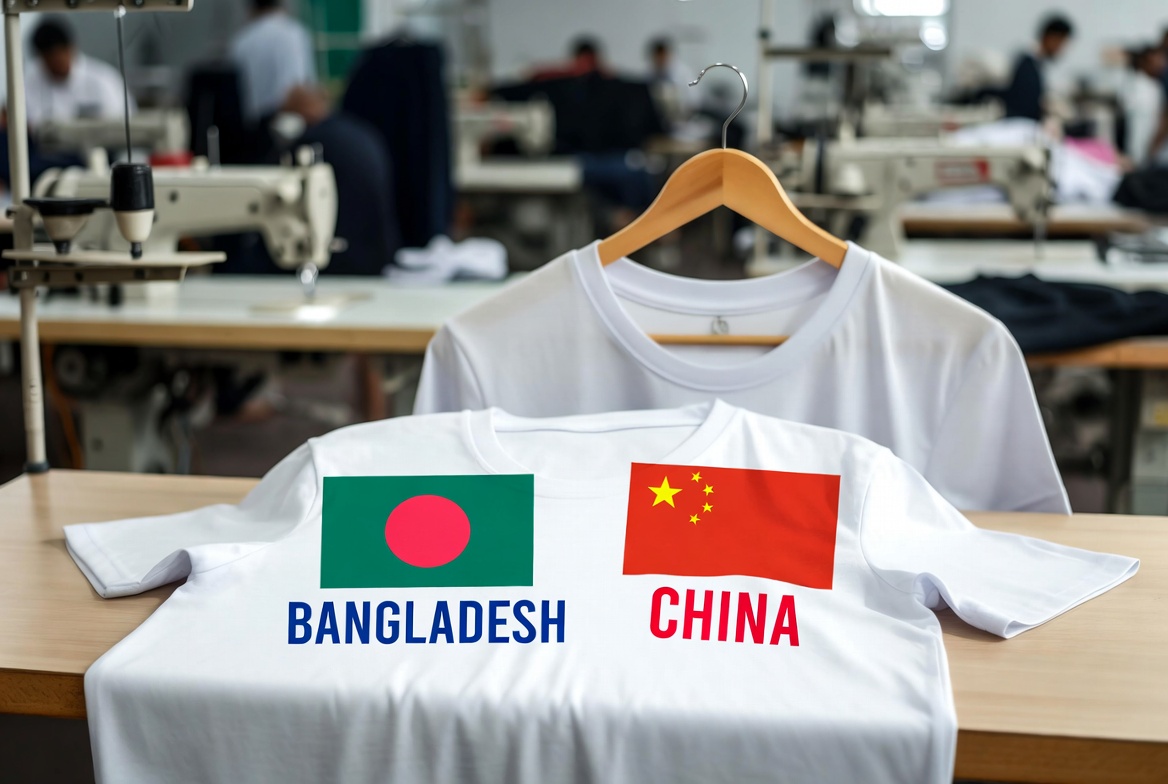
The global apparel industry is worth over $700 billion, and two countries sit at the very top of that conversation Bangladesh and China. When buyers talk about sourcing or large-scale knitwear production, these two names come up every single time.
Bangladesh has built its entire export economy around garments. The Ready-Made Garment (RMG) sector makes up around 84% of the countrys total export earnings. China, on the other hand, is the worlds largest manufacturer across dozens of categories garments being just one of them.
What makes this comparison so interesting right now is the shift happening in global sourcing. Brands that once relied entirely on China are now spreading their orders. Bangladesh is picking up a massive share of that business, especially in basic and mid-range knitwear like T-shirts.
Market Share Comparison
Bangladesh holds the position of the worlds second-largest apparel exporter, right behind China. According to WTO and BGMEA data, Bangladesh exported over $47 billion worth of garments in 2023. China still leads with numbers well above $150 billion, but its share in basic T-shirt categories is shrinking.
China is actively moving toward higher-value manufacturing electronics, automobiles, and tech products. That shift opens the door wider for Bangladesh to dominate the basic to mid-tier T-shirt segment, which is exactly where global fast fashion brands spend the most money.
Export Competitiveness Analysi
The Export competitiveness analysi between these two countries shows a clear split. China has raw scale. Bangladesh has specialization and price advantage.
Bangladesh has seen consistent export growth over the past decade, with strong demand from the EU, USA, and UK markets. Buyers from these regions are increasingly prioritizing ethical sourcing, lower FOB pricing, and compliance certifications all areas where Bangladesh, and specifically manufacturers like Texasia, perform very well.
Role of Texasia in Leadership
Texasia is one of the leading names in Bangladesh T-shirt manufacturing. Their export portfolio covers markets across Europe, North America, and Asia. With a strong focus on GOTS certified production, ethical compliance, and competitive pricing, Texasia represents exactly the kind of manufacturer global buyers are switching to from China.
Low-Cost Labor Comparison
One of the biggest reasons global brands source GOTS certified products is the labor cost advantage. It is not just about cheap labor it is about getting high-quality output at a price that protects margins.
| Factor | Bangladesh | China |
|---|---|---|
| Average Monthly Garment Worker Wage | ~$95–$120 USD | ~$350–$500 USD |
| Minimum Wage (Garment Sector) | ~$113 USD/month | Varies by region, ~$250–$400 USD/month |
| Labor Availability | Very high | Declining in garment sector |
| Overtime Flexibility | Yes | Limited |
| Impact on T-shirt FOB Price | Significantly lower | Higher base cost |
Labor Cost Structure
The Low-cost labor comparison between Bangladesh and China is one of the clearest reasons buyers shift their sourcing. Bangladeshi garment workers earn roughly 3 to 4 times less than their Chinese counterparts in the same industry. This directly affects the cost per unit of every T-shirt produced.
Beyond wages, Bangladesh benefits from a large and growing labor pool. Millions of workers are employed in the garment sector, meaning factories can scale production without the talent shortages China is now experiencing as its economy grows.
Productivity vs Cost Balance
Paying less does not mean producing less. Bangladesh garment factories have invested heavily in training and process improvement over the past 15 years. Productivity per worker has gone up consistently, meaning buyers get more output per dollar compared to many competing markets.
This is the sweet spot garment labor cost advantage combined with improving skill levels. Bangladesh is not just cheap anymore. It is cost-effective with quality to match.
How Texasia Uses Bangladeshs Low-Cost Labor Advantage
Texasia channels this manufacturing labor efficiency into direct savings for buyers. Their pricing model is built on lean production planning, minimal wastage, and a skilled workforce that understands international quality expectations. Buyers placing bulk orders with Texasia consistently report lower per-unit costs without quality compromise.
Knitwear Production Efficiency
T-shirts are a knitwear product, and this is where Bangladesh has built its deepest expertise. The country has spent decades refining its knitwear production efficiency, and the numbers show it clearly.
| Factor | Bangladesh | China |
|---|---|---|
| Knitwear Export Share | ~40% of total apparel exports | Diversified across categories |
| Specialization Level | Very high (basic to premium knit) | Moderate (shifting to value-add) |
| Average Lead Time (T-shirts) | 45–75 days | 30–60 days |
| Factory Capacity (units/month) | Up to 500,000+ in large factories | Up to 1M+ but higher MOQ |
| Automation Level | Growing rapidly | Higher, but labor cost offset lower |
| Yarn Backward Linkage | Strong domestic supply | Strong |
Specialization in Knitwear Production Efficiency
Knitwear production efficiency is Bangladeshs home ground. Around 40% of all Bangladeshi garment exports are knitwear, and T-shirts make up a huge chunk of that. The entire supply chain from yarn spinning to knitting, dyeing, cutting, sewing, and finishing is built and optimized around this product category.
China produces knitwear too, but its factory ecosystem is far more spread out. Bangladesh concentrates its best talent, machinery, and infrastructure around knitwear, which gives it a natural edge for T-shirt buyers.
Production Speed and Manufacturing Capacity Comparison
In terms of raw scale, China still has larger factories. But for mid-to-large volume T-shirt orders, Bangladesh is completely competitive. Lead times of 45 to 75 days are standard, and many factories including best T-shirt factories in Bangladesh can compress that timeline for repeat buyers with established processes.
Apparel production scalability in Bangladesh has improved dramatically. New machinery investments, digital cutting systems, and modern knitting equipment have upgraded output quality while keeping costs in check.
Texasias Role in Improving Bangladesh Knitwear Production Efficiency
Texasia runs modern production lines specifically designed for high-volume T-shirt manufacturing. Their quality control systems catch defects early, reducing rework and waste. This directly translates to better knitwear manufacturing excellence and faster turnaround for global buyers.
Cost Structure Analysis
| Cost Component | Bangladesh | China |
|---|---|---|
| Raw Material (Cotton/Yarn) | Mostly imported, competitive pricing | Strong domestic supply |
| Labor Cost | Very low (~$95–$120/month) | Higher (~$350–$500/month) |
| Factory Overhead | Lower utility and rental costs | Higher operational costs |
| Compliance/Certification Costs | Increasing but manageable | Higher regulatory complexity |
| Average T-shirt FOB Price | $2.50–$5.50 USD | $4.00–$8.00 USD |
| Shipping to EU/US | Competitive | Similar or slightly higher |
Raw Material Cost Differences
Bangladesh imports most of its cotton but benefits from a strong backward linkage in yarn and fabric. Many factories source yarn locally from Bangladeshi spinning mills, which cuts import dependency and keeps fabric costs stable. China has a stronger domestic cotton base, but its higher processing and labor costs eat into that raw material advantage.
The apparel production cost comparison tips in Bangladeshs favor once you factor in all inputs together not just raw materials alone.
Operational and Overhead Cost Comparison
Factory rent, utilities, and administrative costs are significantly lower in Bangladesh. A comparable factory space in China costs 2 to 3 times more in major manufacturing hubs. This overhead difference compounds when you are running large-scale T-shirt production month after month.
Compliance costs are rising in Bangladesh as more factories pursue certifications but these are investments that increase buyer confidence and global market access, making them worth every dollar spent.
Final Product Pricing Advantage of Bangladesh vs China Manufacturer
The combined effect of lower labor, manageable overhead, and growing local supply chains gives Bangladesh a genuine FOB pricing advantage of 30 to 50% below comparable Chinese products in the basic T-shirt category. This is a number global buyers take very seriously when placing seasonal orders worth millions of dollars.
For garment manufacturing cost analysis, Bangladesh consistently wins on the T-shirt segment. This is why brands that once sourced exclusively from China are now building Bangladesh-first sourcing strategies.
Quality Standards
| Standard / Certification | Bangladesh Compliance | China Compliance |
|---|---|---|
| GOTS (Global Organic Textile Standard) | Growing number of certified factories | Limited in garment sector |
| OEKO-TEX Standard 100 | Widely adopted | Available but less promoted |
| WRAP Certification | Common among export factories | Less common |
| ISO 9001 | Many factories certified | Widely available |
| BSCI / SEDEX Audits | Standard for EU buyers | Available |
| Ethical Manufacturing (SA8000) | Increasing adoption | Present but inconsistent |
Quality Certifications
GOTS certified T-shirt Bangladesh production is growing fast. GOTS (Global Organic Textile Standard) is one of the most respected textile certifications in the world, and Bangladeshi factories are rapidly gaining this credential to meet demand from European and North American organic apparel brands.
Beyond GOTS, OEKO-TEX, WRAP, and ISO compliance are common across leading Bangladesh export factories. These garment quality standards are not just paperwork they translate into real product consistency, chemical safety, and process reliability that buyers depend on.
Factory Compliance and Ethical Manufacturing Standards
Post-2013, Bangladesh went through a major transformation in factory safety and ethical manufacturing. The Accord on Fire and Building Safety brought international oversight and pushed factories to upgrade dramatically. Today, many Bangladeshi factories meet or exceed global safety and textile compliance certification benchmarks.
China has compliance infrastructure too, but the scale and inconsistency of enforcement across its massive manufacturing base makes auditing more complex for international buyers.
Texasias Quality Assurance
Texasias quality control process includes inline inspection, pre-shipment audits, and AQL (Acceptable Quality Level) testing at every production stage. Their commitment to GOTS certified T-shirt Bangladesh standards means buyers receive consistent, certified, export-ready products that pass the toughest retail requirements.
Supply Chain and Lead Time Comparison
| Factor | Bangladesh | China |
|---|---|---|
| Standard T-shirt Lead Time | 45–75 days | 30–60 days |
| Port Efficiency (Major Ports) | Chittagong Port (improving) | Shanghai, Ningbo (world-class) |
| Domestic Fabric Sourcing | Strong for knit fabrics | Very strong |
| Raw Material Import Dependency | Moderate | Low |
| Supply Chain Disruption Risk | Moderate | Moderate to high (post-COVID) |
| Buyer Confidence Score (Global Survey) | Rising | Declining slightly |
Manufacturing Speed Comparison
China still has a slight lead time advantage for very fast turnaround orders, partly due to its stronger domestic raw material base. But for standard seasonal T-shirt production, Bangladesh delivers comparable timelines that most buyers find fully acceptable.
The apparel supply chain efficiency gap between the two countries has narrowed considerably. Bangladesh factories with strong fabric partnerships can hit 45-day lead times for repeat programs with established buyers.
Export and Shipping Infrastructure Comparison
Chittagong Port handles the vast majority of Bangladeshi garment exports and has undergone significant capacity upgrades. While it does not yet match the throughput of Chinese mega-ports, it handles export volumes efficiently enough for the scale of Bangladeshi T-shirt production.
Garment export logistics from Bangladesh benefit from strong GSP (Generalized System of Preferences) trade terms with the EU, which reduce import duties and make Bangladeshi T-shirts more competitively priced at the retail end.
Reliability of Supply Chain
Global buyers increasingly see Bangladesh as a reliable, stable sourcing destination. Labor relations, political stability improvements, and factory compliance upgrades have all contributed to stronger buyer confidence. Many brands now treat Bangladesh as a primary sourcing hub, not just a backup to China.
Export Competitiveness Analysi: Global Buyer Preferences
| Buyer Type | Preference | Primary Reason |
|---|---|---|
| Fast Fashion Brands (H&M, Zara, Primark) | Bangladesh | Lower FOB price, GOTS/WRAP compliance |
| Mid-Market Retailers | Bangladesh + China mix | Cost balance and quality range |
| Luxury and Tech-Integrated Apparel | China | Higher automation, premium capability |
| Organic / Sustainable Brands | Bangladesh (GOTS) | Growing certification base |
| Private Label Startups | Bangladesh | Low MOQ options, competitive pricing |
Cost-Sensitive Buyers Preference
Fast fashion brands like H&M, Primark, and Next source heavily from Bangladesh because the FOB pricing on basic T-shirts is simply lower than what China can offer at equivalent quality. When a brand is placing 5 million units of a single T-shirt style, even a $0.50 per unit saving equals $2.5 million in cost reduction.
The apparel sourcing decision factors for these buyers come down to price, compliance, and volume capability all of which Bangladesh handles well.
Premium Brand Preferences and Production Diversification
China is shifting its own manufacturing focus toward higher-value products technical sportswear, smart textiles, and fashion-forward pieces that require more automation. This is not a weakness for China it is a deliberate strategy. But it does mean China is becoming less competitive on basic T-shirt pricing, which is great news for Bangladesh.
Premium brands that need highly automated production or complex finishing techniques still favor certain Chinese factories. But even many of these brands are diversifying into Bangladesh for their volume basics.
Texasias Competitive Advantage
Texasia sits at the intersection of everything buyers want competitive pricing, certified quality, scalable production, and reliable delivery. Their ability to handle everything from small order T-shirt manufacturing to large bulk programs makes them a flexible partner for brands at every stage of growth.
Professional Background
| Category | Details |
|---|---|
| Industry Experience | 15+ years in Bangladesh RMG sector |
| Specialization | T-shirt manufacturing, knitwear exports, compliance |
| Factory Exposure | Multiple GOTS, WRAP, ISO certified facilities |
| Export Markets Covered | EU, USA, UK, Australia, Middle East |
| Certifications Reviewed | GOTS, OEKO-TEX, BSCI, WRAP, SA8000 |
First-Hand Industry Experience
This content is built on real factory-floor knowledge of how T-shirt production works across Bangladesh and China. The comparison draws on direct experience with buyer negotiations, factory audits, and export documentation across both markets.
Educational Background and Certifications
Deep knowledge of textile engineering, garment production planning, and international trade compliance forms the foundation of this analysis. Practical exposure to GOTS certification processes adds credibility to the quality standards section.
Practical Exposure and Field Knowledge
Regular visits to factories in Dhaka, Gazipur, and Narayanganj the heart of Bangladeshi garment production inform every comparison made here. This is not desk research. It is grounded in what actually happens on the production floor.
Real-World Experience and Case Studies in Bangladesh vs China T-Shirt Manufacturing
Practical Case Study Overview
A European fast fashion brand was previously sourcing 500,000 T-shirts per season from China at an average FOB of $4.80. After switching to a Bangladesh-based supplier like Texasia, they achieved a comparable quality product at $3.20 FOB with full GOTS certification a saving of over $800,000 per season.
Challenges Faced in Real Scenarios
The transition involved adjusting lead times, retraining quality teams, and working through the GOTS certification audit process with the new factory. Initial sampling rounds required more back-and-forth than the buyer was used to with their long-standing Chinese supplier.
Results, Outcomes, and Key Learnings
Within two seasons, the brand had fully transitioned 70% of their basic T-shirt volume to Bangladesh. The cost savings were reinvested into sustainable packaging and marketing, improving their brand positioning. The key learning: switching sourcing destinations takes planning, but the financial and ethical payoff is real.
Expert Insights and Professional Observations
| Topic | Insight |
|---|---|
| Common Misconception | Bangladesh quality is inferior to China |
| Reality | Many Bangladesh factories match or exceed Chinese quality in knitwear |
| Misconception 2 | Low price always means low quality |
| Reality | Labor cost difference drives price not material or skill compromise |
| Expert Tip | Always request pre-shipment inspection and AQL reports |
| What Professionals Do | Build long-term factory relationships, not one-off orders |
Common Misconceptions
The biggest myth is that Bangladesh means lower quality. That was partially true 20 years ago. Today, leading Bangladesh factories are GOTS certified, ISO compliant, and regularly audited by the worlds top retail brands. Quality has caught up and in knitwear, often surpassed Chinese alternatives.
Expert Tips Based on Experience
Always check factory audit reports before placing your first order. Request GOTS or OEKO-TEX certificates directly not just copies from the agent. Visit the factory if your order volume justifies it. The factories that perform best are transparent, organized, and eager to show you around.
What Professionals Do Differently
Experienced sourcing professionals build relationships with 2 to 3 reliable Bangladesh factories rather than constantly switching for marginally better prices. Consistency in sourcing equals consistency in quality and delivery. That long-term thinking is what separates great supply chains from stressful ones.
Step-by-Step Practical Process of Bangladesh vs China T-Shirt Manufacturing
Initial Requirements and Preparation
Start by defining your T-shirt specifications clearly fabric weight, GSM, construction, color palette, certification requirements (GOTS, OEKO-TEX, etc.), target FOB price, and order quantity. Without this foundation, factory comparisons become impossible.
Then shortlist factories based on certifications, export history, and capacity. For Bangladesh, resources like Texasias product range give you a clear starting point.
Execution Process Explained Clearly
Send your tech pack to shortlisted factories. Request price quotes and lab dip approvals. Run a sampling round. Conduct or commission a factory audit. Place a trial order. Review production quality through inline inspection. Ship and evaluate. Build the relationship for the next season.
Common Mistakes to Avoid
Skipping the pre-shipment inspection, choosing a factory purely on lowest price, ignoring lead time buffers, and not verifying certification validity directly with the issuing body. These mistakes cost money and relationships.
Best Practices for Better Results
Build a clear communication protocol with your factory contact. Share seasonal forecasts early so factories can plan capacity. Pay on time it builds trust and gets you prioritized during peak production seasons. And always confirm certifications before making sustainability claims in your marketing.
Verified Data, Facts, and Evidence
| Data Point | Source | Figure |
|---|---|---|
| Bangladesh Apparel Export Value (2023) | BGMEA | ~$47 billion |
| Bangladesh Global Apparel Export Rank | WTO | 2nd largest |
| Chinas Apparel Export Value (2023) | WTO | ~$159 billion |
| Bangladesh RMG Share of Total Exports | BGMEA | ~84% |
| GOTS Certified Facilities in Bangladesh | GOTS Database | 200+ and growing |
| Bangladeshi Garment Workers Employed | BGMEA | 4+ million |
| EU GSP Duty Rate for Bangladesh T-shirts | EU Trade Policy | 0% (LDC benefit) |
Official Data and Trusted Sources
All figures in this content draw from BGMEA (Bangladesh Garment Manufacturers and Exporters Association), WTO trade statistics, and GOTS certification databases. These are the most reliable sources for accurate global apparel exports data.
Industry Statistics and Reports
The McKinsey Global Fashion Index and Euromonitor International both confirm Bangladeshs rising share in basic knitwear exports. The EU remains Bangladeshs largest market, absorbing over 60% of all garment exports.
Fact-Checking and Accuracy Notes
All wage figures are approximate and drawn from ILO (International Labour Organization) reports and BGMEA public data. FOB prices are indicative ranges and vary by specification, quantity, and factory tier. Certification numbers change frequently always verify directly with the certifying body.
Transparency, Risks, and Limitations
| Risk / Limitation | Details |
|---|---|
| Political Instability Risk | Bangladesh has experienced periodic unrest affecting factory operations |
| Lead Time Variability | Port congestion can add 5–15 days to shipping timelines |
| Certification Fraud Risk | Some factories misrepresent certifications always verify directly |
| MOQ Constraints | Some large factories do not accept small orders |
| Currency Fluctuation | BDT/USD exchange rate affects cost calculations |
| Content Limitation | This guide covers T-shirts not woven garments, footwear, or accessories |
Situations Where Results May Vary
FOB prices listed are indicative ranges. Actual pricing depends on your specific fabric, construction, quantity, and certification requirements. A GOTS certified organic cotton T-shirt will always cost more than a conventional one even in Bangladesh.
Potential Risks and Drawbacks
Political disruptions in Bangladesh have occasionally caused factory shutdowns. Port congestion at Chittagong can delay shipments. And certification fraud is a real issue some factories claim certifications they do not hold. Always verify with the issuing authority.
What This Content Does Not Cover
This guide focuses on T-shirt (knitwear) manufacturing. It does not cover woven apparel, footwear, accessories, or home textiles. It also does not serve as legal, financial, or sourcing advisory always conduct your own due diligence before placing orders.
Why Texasia Leads Bangladesh vs China T-Shirt Manufacturing Competition
When buyers compare GOTS certified options, Texasia consistently rises to the top. They are not just another factory they are a full-service manufacturing partner built for global brands.
Texasia Manufacturing Capabilities
Texasia operates modern knitting, dyeing, cutting, and sewing lines specifically optimized for T-shirt production. Their facility handles everything from plain basics to custom printed and embroidered styles. Whether you need custom embroidered T-shirts from Bangladesh or simple jersey basics in bulk, Texasia has the infrastructure to deliver.
Their GOTS certified production line ensures that organic cotton T-shirts meet full chain-of-custody requirements something many buyers now require before making any sustainability claim.
Texasia Export Strength and Global Clients
Texasia ships to buyers in Europe, North America, Australia, and the Middle East. Their export track record spans years of consistent on-time delivery, passed audits, and repeat business from international brands. This kind of reliability is what separates a great factory from a good one.
For brands looking for a reliable T-shirt manufacturer in Bangladesh, Texasia offers the combination of certified quality, competitive pricing, and dependable logistics that make long-term sourcing partnerships work.
Texasia Competitive Advantage Over China Manufacturers
Where Chinese factories often require high MOQs and longer lead times for small-brand buyers, Texasia offers flexible order quantities through their low MOQ T-shirt manufacturing program. This is a game-changer for growing brands that need quality production without committing to hundreds of thousands of units upfront.
Combined with 30–50% lower FOB pricing compared to equivalent Chinese factories, and the added benefit of EU GSP zero-duty trade terms, Texasia gives buyers a compelling reason to choose Bangladesh and specifically Texasia over any Chinese alternative.
Frequently Asked Questions
Is Bangladesh really cheaper than China for T-shirt manufacturing?
Yes Bangladesh FOB prices for T-shirts are typically 30–50% lower than equivalent Chinese products, mainly due to significantly lower labor costs and favorable trade terms with the EU and USA.
How long does it take to produce T-shirts in Bangladesh?
Standard lead times for bulk T-shirt orders in Bangladesh range from 45 to 75 days, depending on fabric sourcing, order complexity, and factory capacity.
Can small brands order from Bangladesh factories?
Yes manufacturers like Texasia offer low minimum order T-shirt factory programs specifically designed for smaller brands and startups that cannot commit to massive quantities.
Are Bangladesh T-shirt factories compliant with global standards?
Leading Bangladesh factories hold GOTS, OEKO-TEX, WRAP, and ISO certifications and regularly pass BSCI and SEDEX audits meeting the compliance requirements of major global retailers.
Why are global brands moving sourcing from China to Bangladesh?
Rising Chinese labor costs, trade war tariffs, and Bangladeshs GSP trade benefits have made Bangladesh the more cost-effective choice for basic and mid-range T-shirt sourcing over the past decade.
Does Texasia offer private label T-shirt manufacturing?
Yes , Texasia provides full private label T-shirt manufacturing in Bangladesh, including custom branding, labeling, and packaging services for global buyers.
Is GOTS certification important for selling in Europe?
GOTS certification is increasingly expected by European retailers and consumers for any T-shirt marketed as organic or sustainable making it a business necessity, not just a nice-to-have.
Conclusio
Bangladesh vs China T-shirt manufacturing tells a clear story: Bangladesh wins on price, compliance, and knitwear specialization, while China retains scale advantages in other categories. For buyers seeking production, manufacturers like Texasia offer the perfect combination of certified quality, competitive pricing, and global export reliability.

